



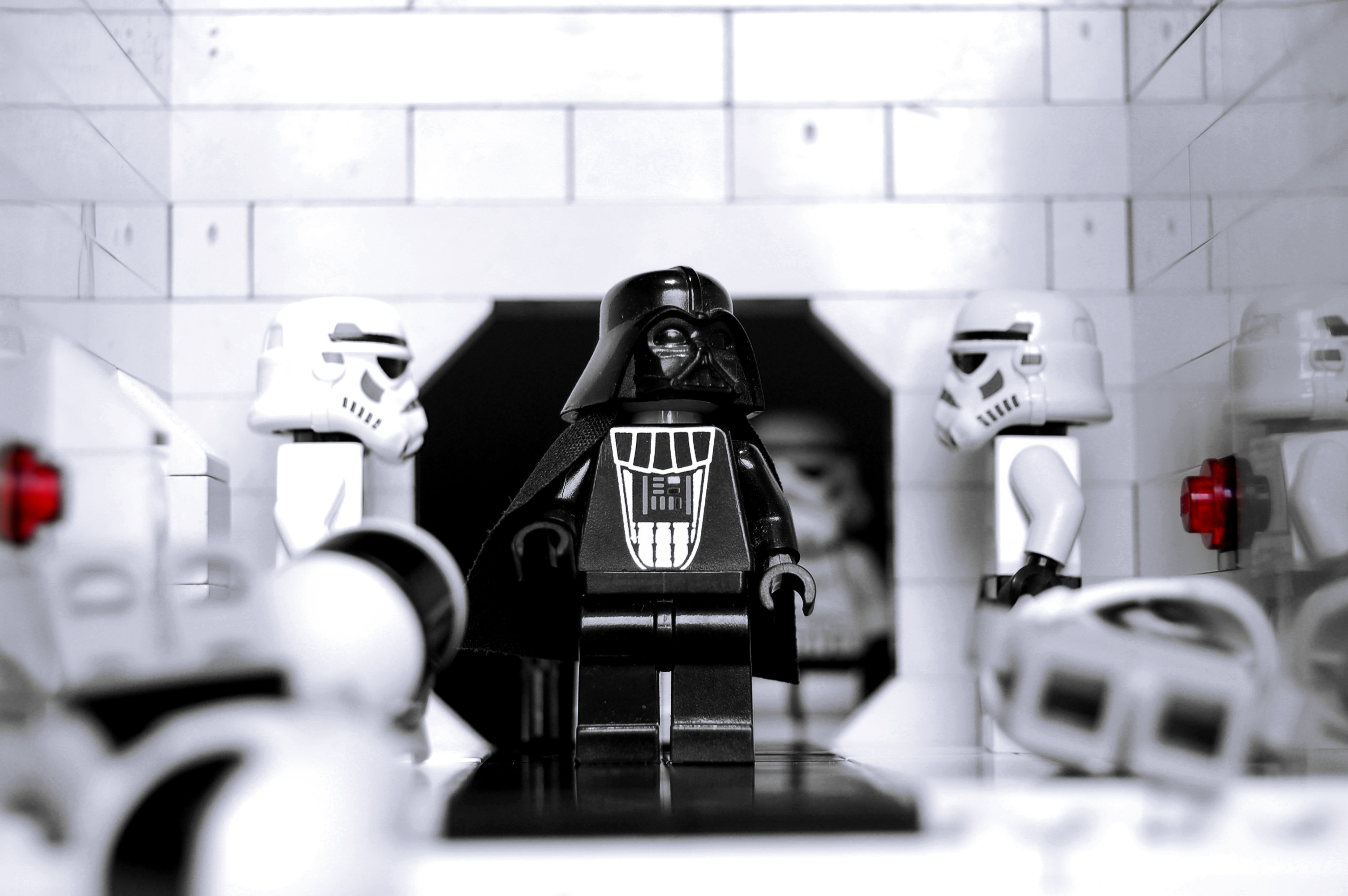
Photo Credit: Rob Young
So, Star Wars. I was about to turn eight years old when it came out, and I loved it as much as the next second grader did. Because . . . I was a second grader. Looking back at the summer of 1977 now, however, wearing my historian’s cap, I have to protest: why are we celebrating this “franchise” in the worshipful way we are, when it contributed so materially to turning us into a nation of eight-year-olds?
A theme of my 2012 book The Invisible Bridge: The Fall of Nixon and the Rise of Reagan was that, following Watergate and then America’s first energy crisis, and in the wake of the loss in Vietnam, America began working through the traumas of its present and past with a hard-won maturity––that “all the turbulence in the 1960s and 1970s had given the nation a chance finally to reflect critically on its power, to shed its arrogance, to become a more humble and better citizen of the world––to grow up––but Reagan’s rise nipped that imperative in the bud.” Hollywood played an important part in the process.
The film industry in the 1960s was still hung over from a series of postwar legal decisions challenging the studios’ monopoly control over film distribution and near feudal control over their actors, and was also in a long slow slide due to competition with television. Hollywood began to give up on its traditional pursuit of reliable returns via predictable stars and formulaic stories. Filmmakers like Martin Scorsese, Arthur Penn, Dennis Hopper, and Robert Altman drew more inspiration from the art cinema of Europe than from the old ways of Hollywood. Their films featured more adult themes, moral ambiguity, dark moods, and a suffusing skepticism toward establishments of every kind. What’s more, they were embraced by the movie-going public. Hits like Bernardo Bertolucci’s Last Tango in Paris (1972), a nearly plotless picture about a kinky random sexual encounter, which made $96.3 million on a budget of $1.25 million, and Francis Ford Coppola’s 1972 and 1974 Godfather films, which treated mainstream and mafia success in the United States as nearly interchangeable and earned in the hundreds of millions, attested to that. The first two starred Marlon Brando at a time when he weighed upwards of 300 pounds and was nearly 50 years old. A willingness to cast leading men who were not conventionally attractive––short, Jewish Dustin Hoffman; sunken-faced Elliott Gould––was another sign of what critics celebrated as the country’s newly maturing cinematic taste.
That, too, felt permanent. At the Oscars in 1976 the deeply subversive, anti-institutional parable One Flew Over the Cuckoo’s Nest––another $100 million earner––took home all five of the major statues. Then came the 1977 Academy Award ceremony on March 28. The best picture also-rans were perfect specimens of perhaps the greatest year for New Hollywood cinema: Network, an over-the-top satire of how TV had addled America’s soul; Bound for Glory, a visually luscious biopic of Woody Guthrie, with depictions of American poverty as searing as any ever committed to the screen; All the President’s Men, about the bone-deep corruption of you-know-who; and Taxi Driver, Scorsese’s sepulchral masterpiece of urban alienation, featuring a Vietnam veteran named Travis Bickle driven insane by the “open sewer” that New York City had become. He tries to assassinate a presidential candidate to impress the child prostitute (played by 13-year-old Jodie Foster) with whom he might have fallen in love, shoots her pimp to death, then somehow ends up celebrated as a hero in a spiraling headlong ending that left viewers speechless and agape. Taxi Driver was horrifying and an unquestioned masterpiece of the cinematic art. Plus, as the 17th-highest-grossing film of the year, it even turned out to be a financial success.
Scorsese attended the ceremony accompanied by an undercover female FBI agent with a handgun in her handbag because a lunatic named John Hinckley had promised to kill him if Jodie Foster won best supporting actress. But Taxi Driver was passed over. Instead, the Academy chose as the best picture of the bicentennial year the Capra-esque, conventionally inspiring, and vaguely reactionary rags-to-riches story––“purest Hollywood make-believe of the 1930s,” the New York Times’s Vincent Canby called it––about an Italian-American boxer who goes the distance against a mouthy black champion modeled on Muhammad Ali, the audience’s every emotion cued by a swelling Old Hollywood-style score.
The award was seen by some critics as a political statement. The other pictures were depressing; the bicentennial year was about feeling good––in the way Sylvester Stallone’s Rocky made you feel good. No matter that it celebrated the morality of white ethnic Philadelphia at a time when their beloved, blustery mayor Frank Rizzo was saying things like, “Just wait after November, you’ll have a front row seat because I’m going to make Attila the Hun look like a faggot.” New Hollywood, and all its vaguely left-wing pretensions, was down for the count. The knockout blow came on Memorial Day.
George Lucas was one of those young directors who got his chance with the New Hollywood wave. The U.S.C. Film School graduate’s first picture, a freakish dystopian sci-fi effort called THX 1138, was a commercial disaster. His next, American Graffiti (1973), about high school kids hanging out in hot-rod crazed early ’60s California, was inspired by Italian neorealist films like Federico Fellini’s I Vitelloni, but was also nostalgic and ebullient––and a hit. “When I did Graffiti,” Lucas later reflected, “I discovered that making a positive film is exhilarating. I thought, ‘Maybe I should make a film like this for even younger kids. . . . I saw that kids today don’t have any fantasy life the way we had––they don’t have Westerns, they don’t have pirate movies.” Or Buck Rogers, John Wayne, Errol Flynn, or Flash Gordon, one might add. The goal he arrived at was to aim his movie at eight- or nine-year-olds. They didn’t have the Old Hollywood adventures he grew up with; neither that Old Hollywood morality. “Everybody’s forgetting to tell the kids, ‘Hey, this is right and this is wrong.’” That’s what he set out to correct. Ronald Reagan couldn’t have said it better. Star Wars was a Ronald Reagan sort of film.
The style, really, is a pastiche of Old Hollywood clichés. A hoary Robin Hood-vintage plot about the rescue of a princess, clad in robes as in a swords-and-sandals Roman epic. Vast desert expanses out of Algiers or Gunga Din. The saloon scene, straight out of Casablanca, if Rick’s Cafe had been populated by monsters out of a 1950s Creature Feature. Han Solo is a Humphrey Bogart doppelgänger: the mercenary whose prickly exterior (“I ain’t in this for your revolution, sister, I’m in it for the money”) is revealed in the last reel as but a self-protective shell of a wounded hero’s heart; Han swoops in to save the day. Costumes recalling grade-B science fiction. And those dog fights: pressed for time in the editing room, they cut one of them as a frame-by-frame match to one of Lucas’s favorite World War II pictures.
There’s more: a fat/thin bickering comedy duo, like Abbott and Costello or Laurel and Hardy (this time they happened to be robots). A rip-off of John Wayne in The Searchers, returning from an adventure to find his beloved homestead in smoking ruins. Tarzan swinging from the vines, Errol Flynn buckling swash, a mincingly cartoonish Nazi gaulatier (“We will then crush the rebellion with one swift stroke.”). Even a nod to the Wizard of Oz: “Help!” C-3PO cries. “I think I’m melting!”
As Peter Biskind documented in his classic history of Hollywood in the 1970s, Easy Riders, Raging Bulls, when Lucas was writing Star Wars in a room in his house with a Wurlitzer jukebox, he was pretty sure it wouldn’t make much money. Lucas’s professional and social frame of reference was his fellow Young Turks of the New Hollywood (his wife was Martin Scorsese’s film editor); his vision of a morality literally framed as darkness versus light was out of step with the cinematic cutting edge. The hot release for the summer of 1977 was expected to be the one his wife was editing, Scorsese’s follow-up to Taxi Driver, the very adult drama New York, New York. “I’ve made what I consider the most conventional kind of movie I can possibly make,” he explained. “This is a Disney movie. . . . All Disney movies make $16 million, so this picture is going to make $16 million.”
But kids didn’t know any of that. And even if you were not a kid, Star Wars was still utterly absorbing. So thrilling and innocent––an invitation to forget about Muslim terrorists, mounting inflation, screaming matches with your crazy relatives over abortion or the ERA, and all that American failure those other movies seemed to want to rub your nose in. Which was why, when Star Wars premiered––at Mann’s Chinese Theater on Hollywood Boulevard, just like in the olden days––the crowds were so large it made Walter Cronkite’s evening news. It grossed $100 million in three months. The story was the same in every theater where it opened. By the end of August, the “novelization” had sold two million copies. By the new school year in September, little boys had put down their bats and balls at recess to trade “Star Wars cards,” and show off little plastic figurines of the characters.
That was only one of the business miracles revealed in the gospel of Star Wars. Another was that kids snapping up toys would go to see a favorite movie again and again. Long ago, in a cinematic universe that suddenly seemed so far, far away, George Lucas had come up with a plan to save his investment: instead of the raise Twentieth Century Fox offered after the success of American Graffiti, he negotiated for the rights to Star Wars-themed merchandise. Because movie tie-in toys did not make money, the money men were glad to take that bet. But when they saw Lucas grow ever-richer from this brand new profit center, and when, by November, Star Wars became the highest-grossing movie of all time, the executives all but officially declared Hollywood’s 1960s over. Beckoning audiences into air-conditioned theaters for pleasant, predictable, escapist fare was just the ticket.
Was it escapism? Think of the recent history: from 1965 through 1973, massive American gunships rained so much ordnance upon North and South Vietnam that by one estimate the entire land mass could have been paved over an eighth of an inch thick with the metal from all the bombs. The planes took off from huge offshore aircraft carriers––you might even call them “Death Stars”––or from colossal air bases like Tan Son Nhat, by 1965 the busiest “airport” in the world. America had upwards of 500,000 soldiers stationed at a time in South Vietnam, equipped with all the best armaments the richest nation in the history of the world could supply, incinerating village upon village in which we were guests.
You might even call us the “Empire.”
And yet we were somehow laid low by a scrappy band of guerrilla warriors, whose weapons were sometimes as crude as sharpened, Ewok-like bamboo spikes. They didn’t defeat us by pin-pointing proton torpedoes into tiny exhaust ports, but it was close: you might say the slow, soiling defeat America watched on TV night after night looked a hell of a lot like the work of a “rebel alliance.”
Here are two relevant passages from the masterful oral history by James G. Zumwalt, Bare Feet, Iron Will: Stories from the Other Side of Vietnam’s Battlefields:
We used everything to shoot at American planes. . . . People from other countries found it hard to imagine we actually used our rifles to shot at these planes. But we first started doing that against French aircraft in 1947. As we had some success with the practice, we continued it against the Americans. . . . There were 43 American planes shot down over a two-day period.
(You might have seen that scene in The Empire Strike Back.)
A power station, a rice mill, and chemical fertilizer factory were located near the bridge. Their presence obviously meant a civilian population was located there, too. Because of the civilian presence, many people did not believe the area would be attacked. We were told otherwise, as these facilities appeared on the Americans’ target list. . . . The air attack came.
(Princess Leia: “No! Alderaan is peaceful! We have no weapons, you can’t possibly . . .”)
And remember this, from the original 1977 Star Wars?
Darth Vader: “We’ve got to use massive force . . . take the dikes out now. Will that drown people?”
Governor Tarkan: “About two hundred thousand people.”
Vader: “No, no, no, I’d rather use the nuclear bomb. Have you got that . . . ?”
Tarkan: “That, I think, would just be too much.”
Vader: “The nuclear bomb, does that bother you? . . . I just want you to think big, Henry, for Christ’s sake.”
Oh, right. My mistake. That was Richard Nixon and Henry Kissinger. But you get the idea. Now, to be sure, the Vietcong and North Vietnamese had sophisticated weapons too, provided by another empire. That was part of the complexity. But no wonder the man who erased that complexity––who granted us the imaginative power to reverse these polarities, and identify ourselves only and always with the scrappy rebels resisting an evil empire (and only two years after the fall of Saigon)––won more wealth than he could imagine. He gave us permission to stop growing up. George Lucas, I mean; though the formulation applies to Ronald Reagan, too.
And now this Christmas we get nostalgia for that nostalgia. Unsurprising––just like the Republican presidential candidates onstage at the CNN foreign policy debate last week aching to release us from the grown-up responsibility to use our power wisely was not surprising. Enjoy the show: that’s fine. I will too. Just remember that infantile denial is what gives Republicans their power––and that the temptation surrounds and penetrates us, too. It binds America together. Just remember that in the end you’re watching a children’s movie.
Rick Perlstein is the Washington Spectator’s national correspondent.