



In July of 1941 over 3000 Jews were murdered by the Nazis and Polish collaborators in my mother’s hometown of Kolno, Poland. Among them were nearly 30 members of our family, including my grandmother’s two brothers, sisters-in-law and their children. The Jews, who made up a majority of the population in Kolno, had lived there for hundreds of years. They were slaughtered on the streets, in their homes, in the town square, and in the Jewish cemetery, though the majority were machine-gunned in ditches just outside the town.
When I went there in 1993 there was no mention of the murders and no sign of the Jewish community, outside of a ruined and abandoned synagogue and a weed-covered field where the cemetery had been. A few months ago, I was contacted by someone else who had family members murdered in Kolno and had just visited the town. While there, she had found that Kolno was celebrating 600 years of its history, from 1425 to 2025. Among other exhibits she encountered was a commemorative display that gave capsule descriptions of the town’s historical highlights, in chronological order. The only mention on it of Jews is that there was a “decline and depopulation [of] 5,163 residents, including 70% of the Jewish population in 1939.” Both the percentage and the year of that “decline” are incorrect, and the reason for the “depopulation” is not stated; in fact the years of World War II are also left off the exhibit.
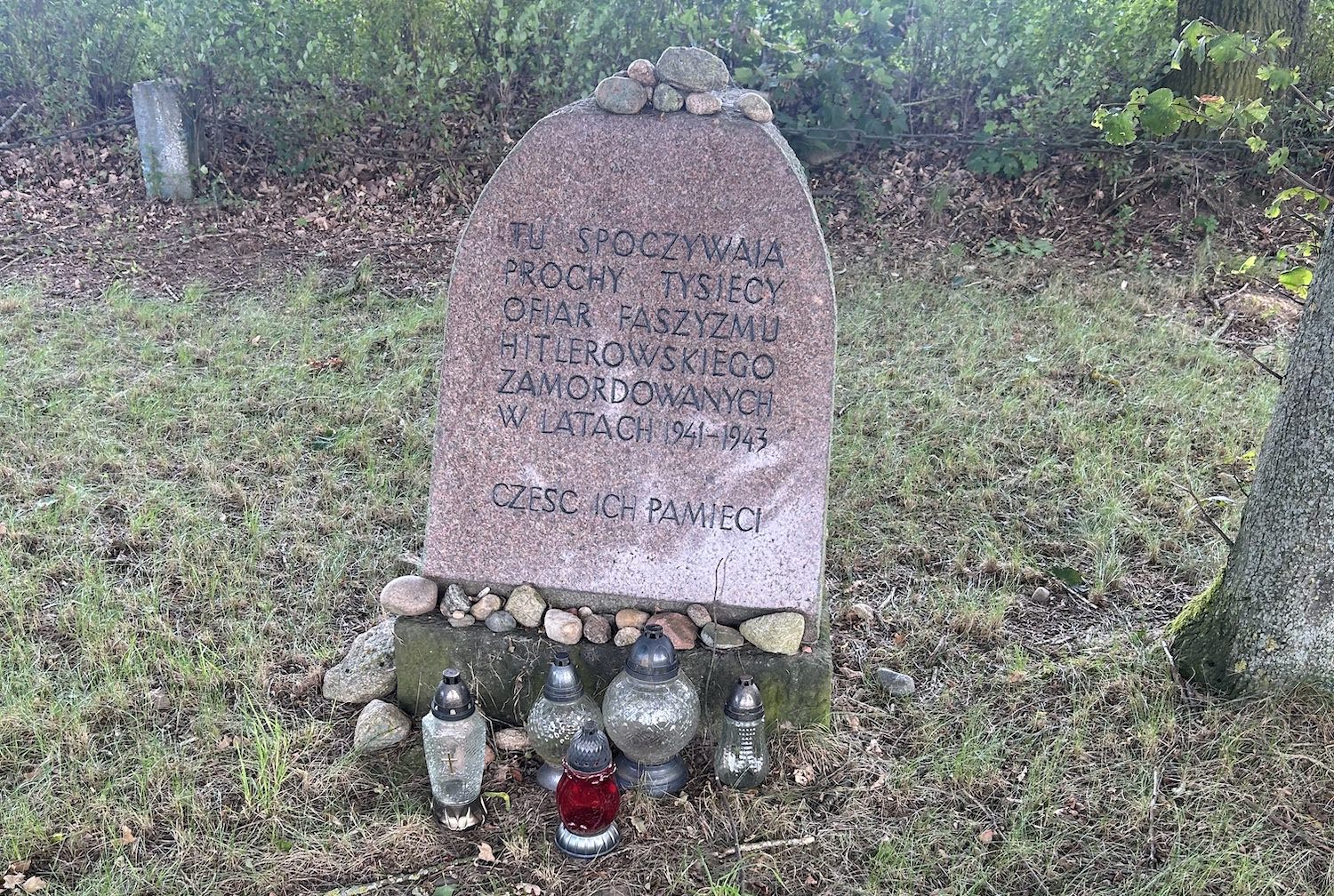
The visitor also sent me a photo of a small, gravestone- shaped memorial stone placed in the ground where the Jews were machine-gunned: something which was not there or which I had missed in 1993. The translation of the Polish is: HERE RESTS THE ASHES OF THOUSANDS OF VICTIMS OF HITLER’S FASCISM IN THE YEARS 1941-1943. DEDICATED TO THEIR MEMORY. There are some small stones stacked on top and at the base, showing there must have been some other Jewish visitors to the site as the custom is to leave stones on tombstones. They proclaim: We Were Here. But there is no mention of Jews at the site. They were erased then and now.
When I told another friend about that erasure, he described it as “historicide.”
Yes. Exactly. The murder of a people’s history. Reading about Kolno’s Jew-washed reinvention of itself, seeing those photographs, infuriated me. But it also inevitably brought me to the eternal conflict, the mutually attempted historicides that mark the war between Israelis and Palestinians.
My mother and my immediate family left Kolno years before the Nazis came, after a pogrom during which she had to hide in a basement as other Jews, her friends and neighbors, were murdered. That event was told and re-told to me as I was growing up, and it was called up for me again by the Hamas pogrom of October 7th, 2023, with its butchery of families hiding in their homes, with its rapes and mutilations of women at the Nova Music Festival: the murders of my mother’s girlhood and the murders of 1941 evoked in 2023 in a nightmare echo. I was not alone experiencing it that way. For many Jews the Hamas slaughter, both its manner and the fact it was happening in the country created to protect us from such massacres, recalled the pogroms of Eastern Europe during the late Nineteenth and early Twentieth Century during which hundreds of thousands of Jews were raped and slaughtered, a precursor to the millions murdered in the Holocaust.
It has often been said that one can’t understand the October 7th massacre without understanding 1948, meaning the context for Palestinians of the Nakba, the loss of Palestine. It is equally true though that for many Jews it didn’t matter that the Palestinians who poured out from Gaza to kill and rape on that day were not Germans or Poles or Russians or Ukrainians or Lithuanians or Estonians or Rumanians or Bulgarians or Hungarians or Croatians: one can’t understand the savage fury of the subsequent assault on Gaza until one understands the Jewish historical nerves enflamed by October 7th.
But to understand the way that pain in part informs what occurred in Gaza is not to justify the scorched earth tactics of the IDF, the tens of thousands of non-combatants, including children, killed, crippled and made homeless. Nor do those past murders and their haunting resonance in the massacres of October 7th validate the recent brutal attacks by ultra-Orthodox Jewish settlers against Palestinian villagers in the West Bank—the terrorizing of families, the burning and uprooting of olive trees, the destruction of homes, the seizing of land, the daily beatings and murders of Palestinians—the, in short, pogroms. The settlers, the so-called “Hilltop Youth” and right-wing members of Knesset Bezalel Smotrich and Itamar Ben Gvir’s other troops, seem obsessed with a need to uproot—as with those trees—all Palestinian presence on the land, to erase their history and create a lebensraum from which they can grow their own roots downwards to meet the perceived roots of their own history. They are doing in the present what the townsfolk of Kolno have done in and to the past. They are attempting to commit historicide.
I can distance myself from those settlers, so alien to me with their dangling sidelocks and their theocratic fascism; they are not the Israel I know, where my friends are on the progressive Left and condemn both the apartheid of the Occupation and the destruction of Gaza; who want to find a way of living equitably with the Palestinians; the Israel whose existence I still see as the necessary answer to thousands of years of persecution and continuing anti-Semitism; the Israel I think of defensively when I see the social media posts and articles by (mainly) non-Jewish friends in which the word Zionism is a pejorative and the very existence of Israel is couched as the greatest evil visited upon the nations of the world.
But the images in my mind from Kolno’s attempt to wipe away its Jewish past juxtaposed with the self-imposed daily onslaught of images I get on my feed of settlers bullying, beating and killing Palestinian farmers, inevitably calls up for me the uncomfortable question of whether what those wannabe retro-Hebrews are attempting is any different than what the Zionist movement did in order to create Israel. Were the founders of Israel the settler-colonialist Shimon Legrees called up by the late Edward Said and Rashid Khalidi and every anti-Zionist poster on Tik Tok? Absent populations and villages as erased as Jewish Kolno, haunt, in difference ways, the consciousness and the subconscious of both peoples as they filter like telling dreams into the work of the poets and writers I turn to for glimpses of the humanity under the skin of the conflict: the poetry or fiction of Palestinian Mahmoud Darwish and Palestinian-American Naomi Shihab Nye and Israelis Yehuda Amichai, David Grossman and Amos Oz.
Yet it was Oz who called into doubt the definition of Israel as a settler-colonialist state when he described the 100-year war between the Jews and Palestinians as a clash of two rights, “two powerful convincing claims,” two contending, if not symmetrical, attempted historicides. “The two nations,” Oz said, “are haunted by their pasts. It may be interesting to point out that both the Israeli Jew and Palestinian Arab are victims of Europe in two different ways. The Arabs were victimized by Europe through colonialism, imperialism, oppression and exploitation, the Jews through suppression, discrimination and, finally, mass murder in the Nazi period. Now, two victims of the same oppressor do not necessarily become brothers. Two children of the same cruel parent do not necessarily hug one another. Sometimes the worst rivalries, in private life as well as in communal life, are precisely the conflict between two victims of the same oppressor. Two children of the same cruel parent look at one another and see in each other the image of the cruel parent or the image of their past oppressor. This is very much the case between Jew and Arab: It’s a conflict between two victims.”
Two victims. Two rights. Two narratives that I can see in the lives of my late cousin Bruria B. and a close Palestinian friend of 40 years, Salah Z.
At 16, a fervent Zionist who ran away to Palestine from her family, in Jedwabne, Poland in 1936, Bruria saw Palestine not only as the historic homeland of an exiled Jewish people, but as a place inhabited by both a native and a growing Jewish community, rooted in that land by history, by the tenets of her religion that clung to a promise of return, and by the need to survive. She regarded herself as a Jew not a Pole, knowing even if she would prefer to be a Pole, the hostility of her non-Jewish neighbors would not permit it. She saw Poland, lived Poland, as a place where she and her people were despised, regarded as eternal and alien outsiders, segregated, blamed unjustly for outlandish crimes, kept in poverty, discriminated against, and often raped and murdered. She regarded herself as a Jew not only because she was hated as one but because she shared a religion, language, history and culture different than the Poles, and which she viewed as being based on a condition of permanent exile.
If she heard the shouted slogan which has become common among adherents of Palestinianism—a term we can use as the mirrored opposite of Zionism—that the Jews in Israel should “go back to Poland” she would find it obscenely blind to the reality of the Poland she knew, which would come to include the mob of Poles, who, under the approving eyes of their Nazi occupiers, had locked her remaining family—her father, mother, and four siblings, along with hundreds of other Jews from Jedwabne—into a barn and burned them to death, a few years after she had run away to the refuge of Palestine.
The man she met and married there was a Tunisian Jew, Shmuel, a Zionist, who managed to migrate some years before he became one of the nearly million Jews from the ancient North African and Middle Eastern Jewish communities who were expelled or needed to flee from their homes and countries when they became the victims of riots, massacres, and government persecution after the birth of the State of Israel (and who now make up the majority of the Jewish population in Israel). He would also have found the admonition to return to Poland puzzling and perhaps comical, as comical as he would find the newly trending description on the Left of his Mizrahi Jewish identity as “Arab-Jew”, negating a history not only of being expelled in the hundreds of thousands from Arab and North African lands in 1948 for the crime of being Jews, but also for centuries living as second-class citizens under the Moslem Dhimmi codes, because they were not Moslems but Jews—like the Kurds, the Druse, the Copts, the Yazdis: separate but not equal to Moslems.
Palestine was a life raft for both of them. They did not see themselves as colonizers, no more than most of the Jews who came to Palestine during the nineteenth and twentieth centuries for the same reasons they had come. Many of them, unlike my cousin, may well have preferred to emigrate to the United States or to South America or—before the rise of Nazism—to Western European countries. But the Immigration Act of 1924 barred most Jews from the United States, and much of the rest of the world shut their doors to them as well, especially in the 1930’s, at the most fraught moment in Jewish history. They knew they did not belong, were oppressed and murdered for decades prior to the Holocaust in the countries of Eastern Europe and in Russia; they thought that to stay there was a death sentence, a belief eventually elevated to a certainty by the Nazis. They saw the creation of a state where Jews would decide their own fate as a life-saving necessity more than as an ideological choice, an attitude recognized by the Palestinian-American scholar Rashid Khalidi who sees Zionism as a settler-colonial enterprise but warns “the settler colonial paradigm is useful only up to a point. And Israel is the most unique case imaginable. No mother country, almost the entire population is there out of persecution, and there is the link to the Holy Land – to the Bible, for God’s sake.” (Italics are mine.)
It may be fair to say that Bruria and her husband saw their attachment to both their sense of peoplehood and to the land of Israel as a refuge not only because of their religious and historical ties to the land but because of their persecution; it may be fair to say that without those two thousand years of being scape-goated, segregated, exiled, and murdered, there would have been no Zionism.
To which Palestinianism (Palestinianists?) would respond, but it was not us who put you into that position, who murdered you, who wanted to exterminate you: Why should we pay for Europe’s sins? You were and are colonizers, no matter how you want to see yourselves, no matter how victimized you were. Your victimization did not give you permission to create victims.
The family of my friend Salah Z, as far back as remembered or recorded, lived in the village of Beit Ikssa, in the West Bank but not far from Jerusalem. He grew up in that city, when, in 1948, his family was separated during what the Palestinians call the Nakba, the Catastrophe which gave my cousin Bruria and her husband a country at the expense of their country. They were outraged by the way one group of outsiders, the British, gave away the homeland to which they were deeply rooted to another group of outsiders, the Jews, who claimed it was their roots buried in that same ground. They fought against that usurpation and lost. In 1947-48, they witnessed the forced expulsions, often at gunpoint, of their people from villages and towns, the massacres of some who tried to stay, their own separation to both sides of the new borders. In 1967, the halves of Salah’s family were reunited when Beit Ikssa was captured during the Six Day War. From that town, they could see new Jewish settlements being built over Arab towns, continuing the process which began for them when the first Jewish settlers began arriving in numbers during the late 19th century, and in ever increasing numbers after the British overthrew Turkish rule in World War I. Under the Occupation they saw their movements restricted, their lands further seized by settlements, their elders and women searched and humiliated by teenage soldiers. They knew how in those destroyed towns, buildings were blown up or bulldozed under, names changed, Arabic inscriptions chiseled over or covered up or simply erased, as was the history of those communities, as was the physical presence and evidence of the Jews of Kolno. The stones left on the graves of Palestine were the scattered or buried remains of lost homes.
She used to say the stone
was smarter than people
because it never went away
—Naomi Shihab Nye, from “Stone House”
The attempted historicide that happened then and that is happening now is based on a denial not only of an Arab connection to Palestine but on a denial that a Palestinian people itself exists. There was never any country called Palestine therefore there are no Palestinians, they are told. Arabs whether they lived in Palestine for hundreds of generations or they migrated from other places were only Arab, they are told.
You are not who you say you are, nor who you think of yourself as being. You have no history. That is the message to my friend Salah.
The other attempt at historicide engaged in by what has become a prevalent form of Palestinianism is based not only on the denial of a Jewish connection to Palestine but also of the very existence of a Jewish people. There is no such thing, we are told. There is no Jewish historical connection to Palestine. There was no Jewish temple on the Temple Mount. No buried Jewish ruins in the land. Jews are Polish or French or English adherents of a religion. Or Khazars. Or Arab Jews.
You are not who you say you are, not who you think of yourself as being. You have no history. That is the message to Israeli Jews. And to me.
Palestinian identity was formed among those Arab inhabitants who had existed before the Nakba as the majority population, with their own unique customs and culture, for hundreds of generations in the land between the river and the sea. Palestinian nationalism was concurrent with the emergence of nationalist and anti-colonialist movements in the 19th and 20th centuries, just as was the emergence of Zionism as a Jewish nationalist movement at that time. The key difference, besides the most obvious ones, was that Zionism was born in opposition to the (mainly) European persecution of the Jews, whereas Palestinianism was born not only in opposition to European colonialism, as Amos Oz remarked, but (mainly) as opposition to the Zionism they saw as an extension of colonialism.
In each case the right of one group of people to define themselves as they interpret their own history is denied by another group of people living in and contesting the same territory.
But what defines a group of human beings as a people is their sense of themselves as a people and a consciousness of unifying connections: in place, language, culture, (sometimes) religion, and history. And in suffering. To tell a group with that kind of consciousness, no matter its genesis, no matter who has more power, that you do not exist so go away or die (or we will make you go away or die) is not a path to peace. Attempting to de-legitimize either Zionism or Palestinianism by telling Jews or Palestinians your people are not a people, is the same as saying you are not a person. You are an olive tree that must be uprooted so that an olive tree may be planted. You are nothing. Your existence makes my existence impossible; therefore, you and yours do not exist. Those words contain the seeds of genocide; they are the words unwritten on the placard commemorating the un-history of Kolno.
We do not need to be reminded:
Mount Carmel is in us
and on our eyelashes the grass of Galilee.
Do not say: If we could run to her like a river.
Do not say it:
We and our country are one flesh and bone.
—Mahmoud Darwish, from Diary of a Palestinian Wound
While the purpose of the historicide in Kolno, Poland, is to cover up murder, the historicides in Israel/Palestine serve to justify and continue murder.
Yet in spite of whatever fever dreams of ethnic cleansing motivate the Right and the settlers’ movement in Israel and fuel the ideology of Hamas and Hezbollah and the Houthis, the reality is that neither people is going anywhere. Both are rooted in the land, by history, by religion, by self-definition, by residence, and by necessity. As Khalidi said, (speaking to the need for Palestinians to find Israeli allies), “[Israel] is not a colonial project in which people can go home. There is no home. They [the Jews] have been in Israel for three or four generations. They’re not going anywhere.”
Among all the obstacles—including the human trait to deny what is inconvenient—to a vision of peace by mutual recognition, perhaps the most intransigent, by its very nature, is religion. “Lord, protect me from your believers. Protect me from those who come in your name to kill,” wrote Darwish in Journal of an Ordinary Grief. There is little reason to believe that the theocratic Islamic fascists of Iran, Hezbollah, and Hamas or of the theocratic Judeo fascist settlers or the Kahanists in the Knesset, will ever accept the existence of any contending narrative that they see as negating their own.
And as much weighted against any solution as religion are the vested interests of leadership and advocacy organizations on both sides whose very existence depends on a continuation of the conflict.
The same might be said of the various Western organizations and movements, simplified as pro-Israel or pro-Palestine, that demonize one side or the other. One doesn’t make peace with demons. One wants them ethnically removed or exterminated, from the river to the sea.
And then there is fear. Fear that your children will be blown up when they go out for pizza. Or carried dead from a school as if in some obscene graduation, like the shot-up Israeli children I saw and photographed in Ma’alot in 1974. Fear that settlers—or a retaliatory bomb-will burn your family alive in your house. Or that like Awdah Hathaleen, a Palestinian activist committed to non-violence, you will be shot to death by a settler with your son in your arms; the settler, Yinon Levi freed after one day in jail. Knowledge-based fear from the lived experience that there will always be extremists on either side who will start killing, start the cycle of death and retribution again, if they see any serious movement towards peace. “We are talking about two peoples so heavily damaged and distorted by past and present traumas that they can no longer identify what their real interests are. And quite often they act against those interests just to cause some damage to the enemy,” said David Grossman.
In the war of narratives, the beginnings of peace will only stir from an understanding of and respect for the history that created each people’s conception of itself, and an understanding of the necessity to move on from that history
From the place where we are right
Flowers will never grow
In the spring.
The place where we are right
Is hard and trampled
Like a yard.
But doubts and loves
Dig up the world
Like a mole, a plow.
And a whisper will be heard in the place
Where the ruined
House once stood.
The Place Where We Are Right, by Yehuda Amichai
Amos Oz, as a writer, favored the truth about human nature that can be found in literature; “Tragedies can be resolved in one of two ways: there is the Shakespearean resolution and there is the Chekhovian one. At the end of a Shakespearean tragedy, the stage is strewn with dead bodies and maybe there’s some justice hovering high above. A Chekhov tragedy, on the other hand, ends with everybody disillusioned, embittered, heartbroken, disappointed, absolutely shattered, but still alive. And I want a Chekhovian resolution, not a Shakespearean one, for the Israeli/Palestine tragedy,” he wrote in In the Land of Israel.
For Oz, the opposite of compromise is not idealism but fanaticism, as it is embodied in the call for historicide on the part of those living inside the conflict and those living outside it, those on the Left or on the Right, who insist on ideological purity. “No justice, no peace,” is both a nice symmetrical slogan and a dire prophecy: an insistence on pure justice ensures there will never be peace. If enough Israelis and Palestinians can come to feel that their very identity, the story by which they understand their lives, is not threatened by the narrative of the Other, that in doing so their physical lives themselves can be made safe, that their self-interest lies not in perpetual war but in some imperfect form of co-existence, then there is the possibility of the curtain finally coming down on the dramas of Macbeth or Hamlet, plays whose intent, one could argue, is to warn rather than to model.
There seems little likelihood for that possibility today. It there is any, it lies not in foreign pressure, not in the international demonization of Israel or of Palestinians, or in agreements between Israel and other Middle Eastern countries, or in the Byzantine machinations of internal Israeli coalition politics, but in the existence of joint Israeli-Palestinian organizations such as Combatants for Peace and Standing Together, and others formed by Jews and Palestinians who know from the pain and losses of their lives the need to find the reflections of themselves in the mirrored lives of those considered eternally Other.
“Let’s change places,” the teenagers said.
For a week, I’ll be you and you be me.”
Knowing if they did, they could never fight again.
Listen to them.
—Naomi Shihab Nye, from Trenches and Moats and Mounds of Dust
Wayne Karlin has published nine novels, a collection of short stories, and three works of non-fiction. His stories, articles and essays have appeared in national publications. He has received six State of Maryland Individual Artist Awards in Fiction, two Fellowships from the National Endowment for the Arts (1994 and 2004), The Paterson Prize in Fiction for 1999, the Vietnam Veterans of American Excellence in the Arts Award in 2005, and the 2019 Juniper Prize for Fiction for A Wolf by the Ears. Wayne also served this year as guest editor with Randy Fertel of “Reflections on the 50th Anniversary of the End of the Việt Nam War,” a special issue published in The Washington Spectator.