




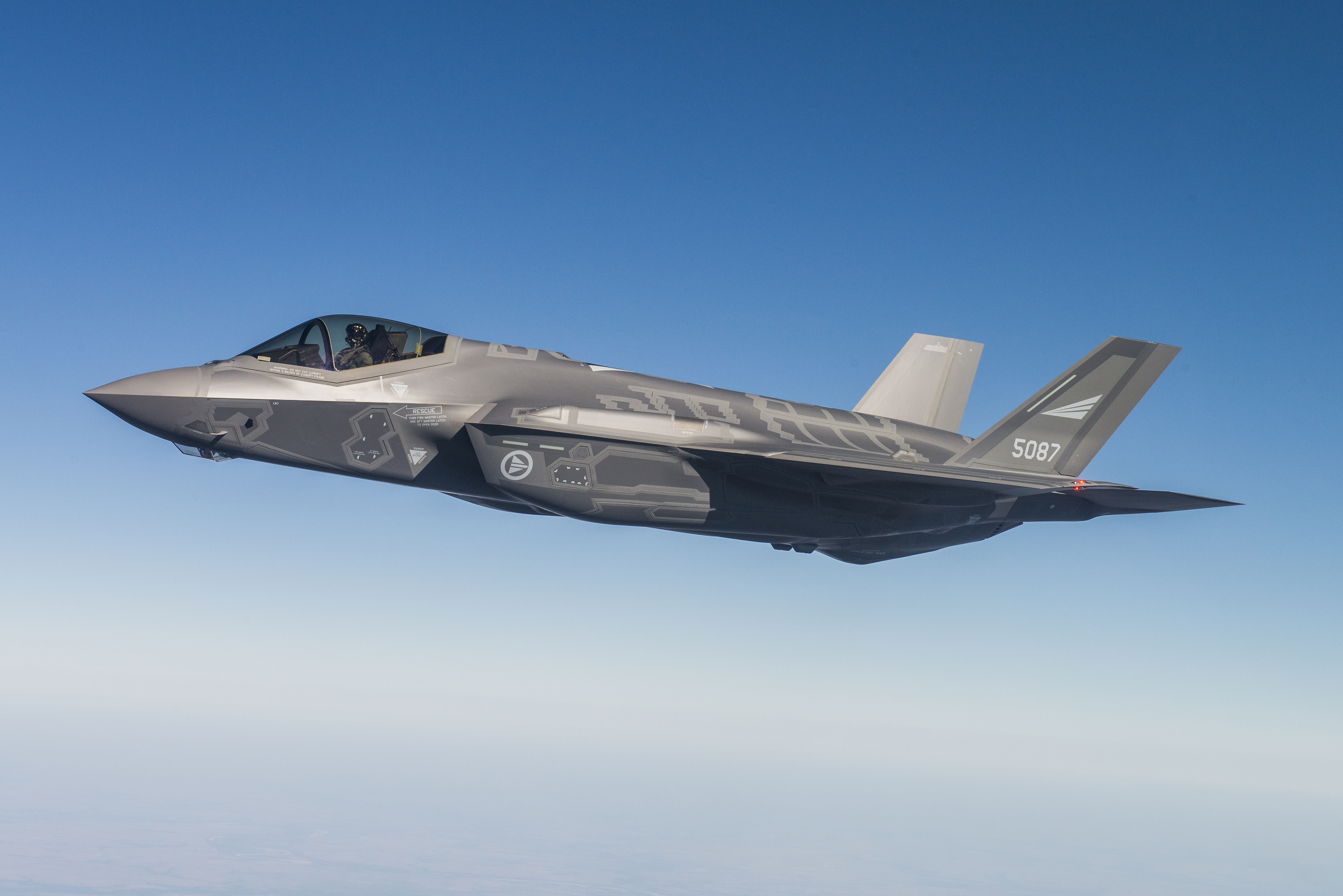
The Pentagon has bet the farm on an airplane championed as a “super fighter” that can do everything for everybody. The F-35 is intended to replace and improve upon several current—and aging—aircraft types with widely different missions. To achieve this, the airplane must meet the mission requirements of the U.S. Air Force, Navy, and Marine Corps, all in one basic airplane. The F-35 is marketed as a cost-effective, powerful, multirole fighter airplane, significantly better than anything potential adversaries could build in the next two decades. But it’s turned out to be none of those things.
Officially begun in 2001, with roots extending back to the late 1980s, the F-35 program is nearly a decade behind schedule, and has failed to meet many of its original design requirements. It’s also become the most expensive defense program in world history, estimated to cost around $1.5 trillion before the fighter is phased out in 2070.
The unit cost per airplane, well above $100 million, is twice what was promised early on. And yet the Pentagon is still throwing huge sums of money at the project. Essentially, it has declared the F-35 “too big to fail.” As a retired member of the U.S. Air Force and currently a university professor of finance, who has been involved in and studied fighter aircraft operations and sustainment, along with system developments and acquisitions, I consider the F-35 to be one of the greatest boondoggles in military purchasing history.
Part of the enormous cost of the F-35 program is the result of an effort to share a single basic aircraft design across different branches of the military. This concept was supposed to be a way of reducing development and sustainment costs, but it has accomplished the exact opposite.
A 2013 study by the RAND Corporation found that it would have been cheaper if the Air Force, Navy, and Marine Corps had simply designed and developed separate and more specialized aircraft to meet their specific operational requirements.
Lockheed Martin, the company building the F-35, said the plane would be far better than current aircraft—“four times more effective” in air-to-air combat, “eight times more effective” in air-to-ground combat, and “three times more effective” in recognizing and suppressing an enemy’s air defenses. It would, in fact, be “second only to the F-22 in air superiority.” In addition, the F-35 was to have better range and require less logistics support than current military aircraft. The Pentagon is still calling the F-35 “the most affordable, lethal, supportable, and survivable aircraft ever to be used.”
But that’s not how the airplane has turned out. In January 2015, mock combat testing pitting the F-35 against an F-16, one of the fighters it is slated to replace, resulted in the F-35’s test pilot noting that the F-35 was less maneuverable and markedly inferior to the F-16 in a visual-range dogfight.
One reason the F-35 doesn’t possess the world-beating air-to-air prowess promised, and is likely not even adequate when compared with its current potential adversaries, is that it was designed foremost to be stealthy to enemy radar. This requirement has taken precedence over maneuverability and undermined its overall air-to-air lethality. The Pentagon and especially the Air Force seem to be relying almost exclusively on the F-35’s radar stealth capabilities for it to succeed at its missions. However, in 1999 the same type of stealth technology was not able to prevent a U.S. Air Force F-117 flying over Kosovo from being located, tracked, and shot down using obsolete Soviet radar and surface-to-air missiles. In the nearly two decades since, that incident has been studied in depth by the Pentagon and by potential adversaries seeking weaknesses in passive radar stealth aircraft.
Radar is not the only way to locate and target aircraft. An aircraft’s infrared emissions, which are created by friction-generated heat as it flies through the air, along with its hot engines, can be used to target it. Several potential adversaries’ fighters possess excellent infrared search and tracking systems to locate and target opposing aircraft. It’s also very common in air-to-air battles for opposing planes to come close enough that their pilots can see each other. The F-35 is as visible as any other aircraft its size.
Lockheed Martin and the Pentagon say the F-35’s superiority over its rivals lies in its ability to remain undetected, giving it “first look, first shot, first kill” capabilities. Hugh Harkins, a highly respected author on military combat aircraft, called that claim “a marketing and publicity gimmick” in his book on Russia’s Sukhoi Su-35S, a potential opponent of the F-35. He also wrote, “In real terms an aircraft in the class of the F-35 cannot compete with the Su-35S for out and out performance such as speed, climb, altitude, and maneuverability.” Other critics have been even harsher. Pierre Sprey, a co-founding member of the so-called “fighter mafia” at the Pentagon and a co-designer of the F-16, calls the F-35 “inherently a terrible airplane” that is the product of “an exceptionally dumb piece of Air Force PR spin.” He has suggested the F-35 would likely lose a close-in combat encounter to a well-flown MIG-21, a 1950s Soviet fighter design. Robert Dorr, an Air Force veteran, career diplomat, and military air combat historian, wrote in his book Air Power Abandoned, “The F-35 demonstrates repeatedly that it can’t live up to promises made for it. . . . It’s that bad.”
How did the F-35 go from its conception as the most technologically advanced, do-it-all military aircraft in the world to a virtual turkey? The F-35 program is the result of combining several separate and diverse projects into a set of requirements for an airplane that is trying to be everything to everyone. With the F-35, it appears designers created an inelegant jack of all trades but master of none—at great expense, both in the past and, apparently, well into the future.
Michael. P. Hughes, Ph.D., is Professor of Finance at Francis Marion University in Florence, South Carolina. Dr. Hughes served over 21 years in the U.S. Air Force. He spent his initial years in the aircraft maintenance and engineering (propulsion) arena with F-4 and F-15 aircraft, followed by over 14 years in nuclear treaty monitoring and related activities.