



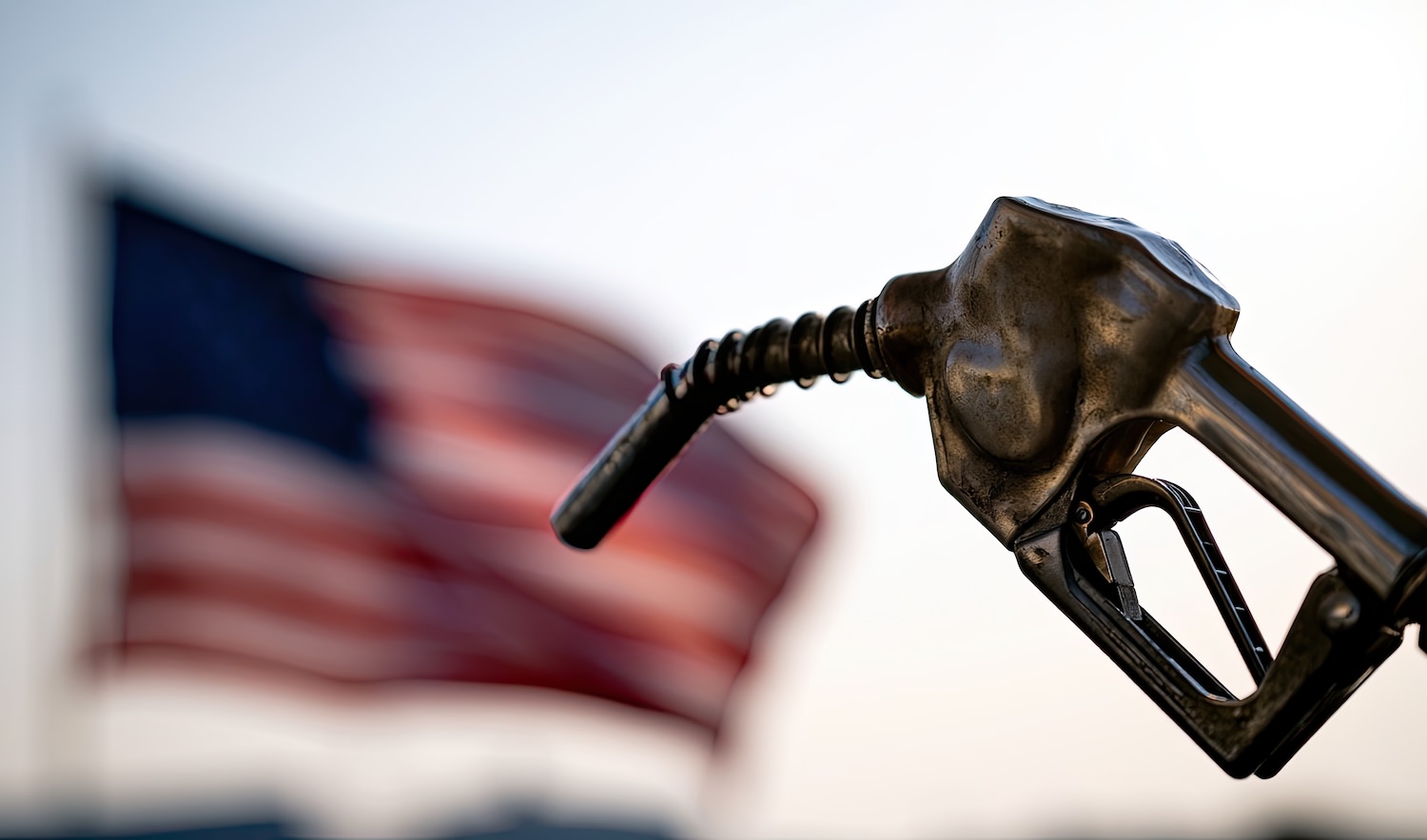
Gasoline prices are rising again, adding to voter concerns about the cost of living. Yet in the Philadelphia region, a new company, Freedom Fuel, is suddenly selling gasoline substantially below its competitors at more than two dozen stations.
President Trump has personally promoted Freedom Fuel, and the White House has presented it as evidence that his energy policies are working. But where the fuel comes from, how the company can sell it so cheaply, and why the President became personally involved remain mysteries. Those questions lead to another: what has happened to the Venezuelan oil and the revenues the Trump Administration now controls?
Mystery Number 1: What is the United States Actually Doing with Venezuela’s Oil Revenues?
Donald Trump has never been shy about claiming credit. But his recent description of Venezuela’s oil was remarkable even by his standards.
“We’re taking their oil,” Trump declared in an August 5 speech in Las Vegas. “To the victor belong the spoils.”
There was more. Trump said “billions and billions of barrels” of oil were coming out of Venezuela, that the United States was taking a substantial share, and that what America had taken had paid for the brief January war “many, many, many times.”
The numbers as stated are of course impossible. Venezuela has not produced billions of barrels since January. With an average of roughly a million barrels per day, total Venezuelan production since the American intervention amounts to only a few hundred million barrels. Even one billion barrels would take Venezuela years, not months, to produce at anything close to its present rate.
Over time, Trump’s account of the U.S. exploitation of Venezuelan oil has evolved.
On January 9, Trump issued an executive order on “Safeguarding Venezuelan Oil Revenue for the Good of the American and Venezuelan People.” The order stated that the oil revenues “constitute property of the Government of Venezuela,” and that the U.S. would hold them “solely in a custodial and governmental capacity.” But by late March, after Secretary of State Marco Rubio explained that proceeds from Venezuelan oil sales were being held in a blocked U.S. Treasury account for Venezuelan public purposes, Trump interrupted: “We get a lot of it.” He repeated the point: “We have a deal. We get a lot of it.” He added, “We got some and they got some.”
Days later, however, in his nationally televised April 1 address, Trump described the relationship between the United States and Venezuela as “in a true sense, joint venture partners,” but immediately added: “We don’t have to be there. We don’t need their oil. We don’t need anything they have.”
By July, Trump was saying that Venezuelan oil was being sent to Houston and Louisiana for refining, stating “we’re taking tremendous amounts of oil” and that the U.S. was now “taking out many, many times the money that we spent on the war.”
By August, he was calling Venezuela’s oil the spoils of victory. This is an extraordinary description of a program the Administration originally described as the safeguarding by the U.S. of sovereign Venezuelan assets pending approved governmental expenditures. A custodian safeguards someone else’s assets. A victor taking the spoils takes something for himself.
If Trump’s repeated descriptions reflect what the Administration is actually doing, they raise a host of questions about what is happening to the hundreds of millions of barrels of oil, with a gross value measured in the tens of billions of dollars, exported from Venezuela under the arrangements established by the Administration after the military operation that grabbed and extradited its then-President.
Over the seven months since the Trump Administration took over custody of the proceeds of Venezuelan oil, the Administration has provided remarkably little information documenting how its custodianship is working in practice. It has provided no public reconciliation showing oil sold, money received, money disbursed and money remaining, and no public accounting of where the billions of dollars are actually being held.
When did the U.S. custodial relationship change to one in which the U.S. is extracting what Trump refers to as “billions?” Who holds the proceeds? How much revenue has actually been received and paid out and to whom? How much money remains? Who, if anyone, is checking the books, verifying the funds coming in and going on, and providing the accounting? What is the legal basis for the U.S. government’s participation in any sharing of Venezuela’s sovereign assets? The questions are obvious. The answers remain glaringly missing.
Mystery Number 2: What is President Trump’s Relationship to America’s Newest Gas Station Network?
According to Delaware corporate records, Freedom Fuel Network LLC was incorporated on June 23, 2026. Within days, the new company had launched a network of 25 gasoline stations across the Philadelphia region and southern New Jersey, offering gasoline at a promotional price of $3.47 a gallon, roughly 40 cents lower than the Philadelphia average.
Six days later on June 29, President Trump publicly warned gasoline retailers to slash gasoline prices immediately or risk federal investigation. Two days later, and two days before Freedom Fuel announced its July 3 launch, Trump effectively introduced Freedom Fuel to the country. “I am pleased to announce,” Trump wrote on Truth Social, “that a VERY smart Retailer” would begin lowering prices at “25 ‘FREEDOM FUEL’ Stations across the Greater Philadelphia Area.” “This Retailer is taking the lead,” Trump wrote. “Others should follow.” The White House later acknowledged that Administration officials had discussions with individuals who established Freedom Fuel but did not provide specifics. Trump knew enough on July 1, two days before the announced July 3 opening, to tell the public the name, number of stations, geographic market, opening date and planned pricing.
On July 3, Freedom Fuel’s opening day, Jarrod Agen, Executive Director of the National Energy Dominance Council, established in the Executive Office of the President, posted two photos of himself giving a “thumbs up” at a new Freedom Fuel station in Philadelphia. He praised Freedom Fuel for selling its gasoline at “fifty cents less per gallon” than the Pennsylvania average and credited Trump with lowering the price of oil.
On July 7, the White House released an official video promoting Freedom Fuel. Its accompanying message declared: “The FIRST Freedom Fuel Network gas station has LANDED,” said that “President Trump is leading the charge to lower gas prices,” and explained that the $3.47 price honored “our 47th President.”
Viewed chronologically, the sequence reads less like a President discovering a successful private business and more like a presidential rollout. It is difficult to identify another instance in modern American history in which a President has personally helped to launch a newly formed private company and then had the White House promote it as evidence of his Administration’s success.
On July 7, the Philadelphia Inquirer became the first news organization to raise questions about Freedom Fuel’s ownership and business model. One month later, The Washington Post, in a subsequent investigation involving six reporters, substantially expanded the factual record. It found that Freedom Fuel was organized by Randy Brown, a former Republican mayor in New Jersey and self-described Trump supporter, together with Yoni Gontownik, an energy investor with commodities-trading experience. Public records examined by the Post also connected the network to established gasoline-station operators, but those involved disclosed little about the venture.
The Post also found that Gontownik recently worked for global commodities trader Mercuria, although Mercuria told the Post that it has no involvement with Freedom Fuel. It reported as well that roughly one-third of Freedom Fuel’s stations occupy properties owned by Blue Owl Capital, a company in which President Trump previously disclosed an investment valued at up to $25 million before later indicating he had largely disposed of the position. The White House told the Post that Trump, his family and businesses have no financial stake in companies connected to Freedom Fuel and that the Administration neither partners with nor subsidizes the company.
That said, the Mercuria connection has another potentially significant dimension. On May 1, Mercuria announced that it had secured Venezuelan commodity agreements as part of what it called a “White House-supported initiative.” Mercuria said the agreements were advanced alongside a high-level delegation of U.S. government officials and industry participants visiting Caracas to facilitate new investment frameworks and supply agreements “in oil and mining.”
Mercuria illustrated its announcement with a photograph of its Managing Director James Gilbert with Jarrod Agen, identified as Executive Director of the National Energy Dominance Council. Beyond the photograph, Agen played a substantial role in the Administration’s Venezuelan energy initiative. He led the U.S. delegation that traveled to Caracas in late April and visited Trump in the Oval Office just before his trip, where he met with Acting Venezuelan President Delcy Rodriguez.
Agen subsequently described the trip himself: “Team NE⚡DC arrived in Caracas … We left with ENERGY DEALS secured!” He specifically identified agreements involving U.S. oil companies and PDVSA, as well as the Mercuria-Heeney agreement. Mercuria thanked Agen for his “leadership,” and Agen separately promoted its announcement. Two months later, Agen appeared at a Freedom Fuel station on its opening day and publicly promoted the new network.
So what explains this relationship?
How did a company incorporated on June 23 have 25 stations operating within days? Who supplies its gasoline? What does it pay? Which refineries produce the fuel? Who financed the rapid expansion? When did White House officials first begin communicating with the company’s organizers? And what led the President personally to introduce and repeatedly promote a company that had existed for little more than a week? What relationship, if any, was there between Agen’s work on the Administration’s Venezuelan energy initiative and his subsequent involvement with Freedom Fuel?
Those questions would warrant investigation on their own. Trump’s evolving descriptions of the Administration’s Venezuelan oil program raise another.
The Administration controls access to a large new stream of Venezuelan petroleum. Trump says the United States is taking some of it, making substantial money from it, and has already recovered many times the cost of the military operation that seized it. At the same time, a newly created gasoline network personally promoted by Trump and the White House has obtained fuel on terms that allowed it, at least initially, to sell substantially below its competitor prices while continuing to decline to disclose its supply arrangements.
Solving the Two Mysteries
The two oil stories already intersect. What remains unknown is how far that intersection goes. The available public evidence cannot presently answer that question. It does provide a concrete reason to ask it.
Among the identifiable explanations, one possibility connects more of the documented facts than any competing explanation supported by public evidence: that Freedom Fuel’s unusual commercial position derives, directly or indirectly, from access somewhere within the Administration’s newly constructed Venezuelan petroleum framework. Whether that advantage, if it exists, involved crude oil, refined product, pricing, financing, contracts or some other commercial mechanism remains unknown.
Congress does not need a theory to investigate this. It needs the documents.
Freedom Fuel has supply contracts, invoices, payment and financing records. Its wholesalers know where they obtained the gasoline. The refiners know what crude they were running. Treasury administers the licenses governing authorized transactions in Venezuelan petroleum. State and Energy also received detailed reports concerning transactions under several of the general licenses that enable Venezuelan oil sales. Those government records, together with commercial records from the companies involved, should resolve much of the factual uncertainty.
Congress should obtain those records from Treasury, State and Energy, together with Freedom Fuel’s own commercial records, and follow the oil in both directions. Congress should also ask Agen what role he played in the Venezuelan initiative described by Mercuria and how he came to promote Freedom Fuel on its opening day.
The press can do much of the same work. The investigation begun by the Philadelphia Inquirer and substantially expanded by The Washington Post has already demonstrated that this story rewards persistent reporting. The unexplained fate of Venezuelan oil and its proceeds deserves the same sustained attention.
Jonathan M. Winer, a former senior State Department official, is a member of The Washington Spectator Editorial Advisory Board. He is also active with The Steady State, a nonpartisan organization of more than 280 former senior national security professionals from the CIA, FBI, Department of State, Department of Defense and Department of Homeland Security which advocates for constitutional democracy, the rule of law and the preservation of America’s national security institutions.