



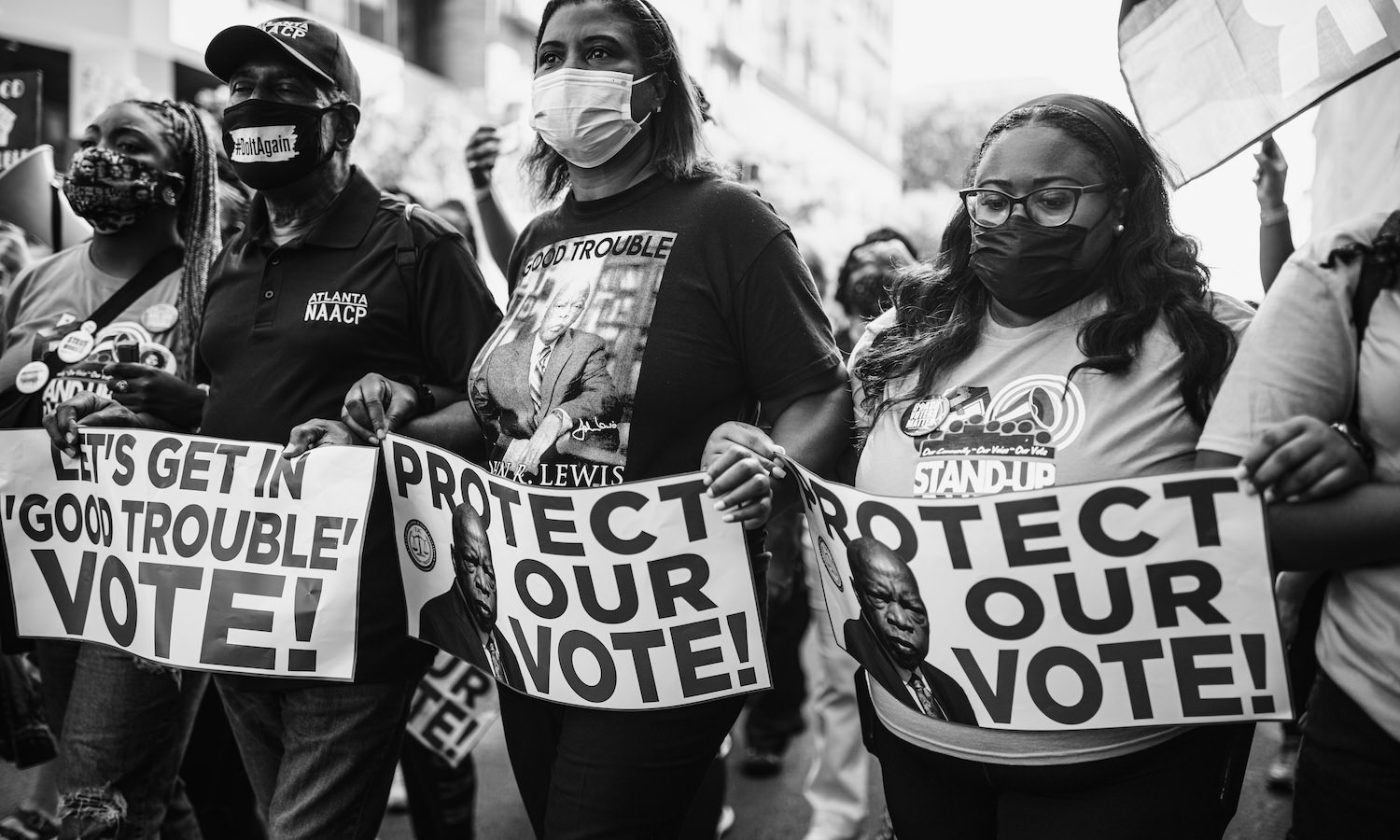
On April 29 of this year the Supreme Court handed down its decision in Louisiana v. Callais, overturning the creation of a Black Majority district in Louisiana, driving a stake into the heart of Section 2 of the Voting Rights Act and effectively dismantling the remaining few legal procedures that have protected the right of Black Americans to vote since the legislation was adopted in 1965.
In advance of this ruling, The African American Policy Forum—led by Kimberlé Crenshaw—convened a public panel at Columbia Law School in New York City on the history of violent and persistent attempts to suppress Black voting rights and the ongoing need for their protection.
Crenshaw engages here in a revelatory conversation with Janai Nelson, President and Director-Counsel of the Legal Defense Fund, who argued Callais in the high court. They are joined by historians Carol Anderson, author of One person, No Vote: How Voter Suppression Is Destroying Our Democracy, and Nancy MacLean, author of Democracy in Chains: The Deep History of the Radical Right’s Stealth Plan for America. – ed.
Kimberlé Crenshaw: Our guiding questions for this conversation are why do authoritarians fear democracy? And what does their fear mean for all of us right now? Now, when we say democracy, yes, we mean your ability to vote, but we also mean your ability to be counted, and more broadly, the ability of our citizenry to shape the conditions of our institutions and our lives, our schools, our communities, safety, opportunity and our future.
But as we all know throughout our nation’s history, there are those who have fundamentally opposed democracy as we have come to know it (and define it for them), the rights that we now take for granted are anathema to them, and the vision of a multiracial and inclusive society that has grown over the 20th century is deeply, deeply discomforting to them, and so they have sought to dismantle it.
Think about how quickly we’ve fallen over the last 20 years. It was only 10 years ago that we celebrated the 50th anniversary of the Selma march to Montgomery, a pivotal moment in the bloody struggle for African American inclusion. And the Voting Rights Act that Johnson signed into law in 1965—a monumental law that a century after we gained our freedom affirmed the rights of African Americans to have a say in our destiny—that law is now on life support and very much at risk 60 years later.
So this commemoration of the march in Selma is fraught with tension, coming now during the worst assault on civil rights since this historic day 60 years ago. The vicious repression unfolding today is as insidious as the assaults that John Lewis, Amelia Boynton, and so many others endured that Sunday where lives were put at stake—even if today’s assaults are less spectacularly visible than the beatings on Bloody Sunday.
Now there is a shift in perspective underway. Formerly, the history that we celebrated shifted the perspective to those who were on the bridge, those who were marching for justice. There was a consensus that a wrong was being done that day, a wrong being done by those riding horses, a wrong being done by those who were wielding the billy clubs. Now we’re seeing a perspective that shifts back to those who are on the other side of the bridge. So the wrong now is being committed by those who are demanding greater inclusion, those who are demanding race conscious remedies, those who are expecting democracy to really include them.
So how have we come to this moment where, morally and constitutionally, we’re shifting away from the story that a wrong was righted by the Voting Rights Act? How are we at the precipice of losing our crown jewel, the Voting Rights Act, in its entirety? The question before us is this: how did we reach a moment where federal protections that once seemed foundational to correcting the central problem of our republic, like section 2 of the Voting Rights Act, are now precarious? Cases that would have been unthinkable 30 years ago are now plausible, even likely. What are the agendas playing out now in plain sight, and what are their conditions of possibility? And what does anti-Blackness have to do with it, and why should everyone care, Black and non-Black?
This conversation feels especially urgent. It will help us see that these are not isolated events, but part of a single project to hollow out democracy, effectuated by deploying anti-Blackness as a tool. That is not to say that anti-Blackness is merely a tactic to divide and conquer, which it is. But the anti-Blackness is also an authoritarian end to facilitate an extremist agenda. In this sense, anti-Blackness hurts everyone who is not in favor of this supremacist, exclusionary vision. With that framing, I welcome my distinguished guests.
So this is a dream come true. When I was growing up, I used to invite my girlfriends over for a night of talking and hanging out, and it was so exciting when they said that they would come. I feel that joy now. It’s just so good to talk about what we’re talking about together, where we actually have a common understanding and can build on each other’s experience.
We want to start everybody off with some element of the problem that we can all see. And then as we go deeper into the conversation, we learn more about the history of this element. We learn more about what it means. And of course, at the end, we want to talk about what to do about it.
We’re going to start with what’s right in front of us. All of you have been talking, writing, litigating about what feels like a coordinated assault on our democracy connected by the mobilization of anti-Blackness. We’ll explore the connections and try to paint a picture of how serious this crisis is.
Janai, last October, you argued Louisiana v. Callais, defending the Voting Rights Act, specifically its section 2. You’ve noted the passage of the Voting Rights Act meant that for the first time since Reconstruction, Black Americans had the freedom to decide who represents them and the freedom to determine what policies govern their communities, and this freedom has been seized. The Voting Rights Act is called the crown jewel of the civil rights movement. What do people mean when they say the Voting Rights Act is the crown jewel? And is this crown jewel, like those in the Louvre museum, being stolen in plain daylight?
Janai Nelson: There are interesting parallels there about these institutions that house something precious that’s not necessarily theirs, that other people created and that they are housing. Unfortunately, the people who are trying to steal it are not trying to return it to the original owner. They’re trying to steal it so no one else can enjoy it.
Calling the Voting Rights Act the crown jewel of the Civil Rights Movement, or the crown jewel of civil rights legislation, did not come from the civil rights activists. It did not come from the people who fought and died and bled for this right to vote. It came from the Supreme Court. As you pointed out, there was a time when people were in accord that this country needed this type of muscular legislation to advance our multiracial democracy.
We now have the same institution, not the same actors, but the same institution entertaining challenges to some of the basic foundational principles of the Voting Rights Act, including the case that I had the privilege to argue, whether Section 2 can allow for certain race-based remedies. But there’s also a case that is coming behind this one that is challenging whether groups like the Legal Defense Fund can even bring cases to enforce the Voting Rights Act, whether there is a private right of action. These are things that are anathema to what we all have understood to be the project of advancing multiracial democracy.
The Voting Rights Act is considered the crown jewel because it did what so many other statutes didn’t. It named even ostensibly race-neutral practices like literacy tests and banned them nationwide because they were being used to disenfranchise; it also recreated ways for us to enforce the Constitution that had laid dormant for nearly a century. It did so much work literally to change the complexion of leadership and representation in this country.
So that’s why we call it the crown jewel. It truly is something that has, I think, transformed this country more than almost any other law, and I think that’s why there’s a target on its back. I was asked by Justice Kagan—what would be the consequences of overturning Section 2? I answered that it would be catastrophic.
If we think back to the time that the Voting Rights Act was passed, there were few Black elected officials in this country. Within a decade of the Voting Rights Act, it was around 1400 nationwide. We’re now upwards of 10,000. While that growth has given Black people the opportunity to elect candidates who will hopefully represent their interests, we know from the conditions of Black people, it hasn’t transformed our conditions as much as we need them to, so this is no time to get rid of this critical protection.
Many of our elected representatives are elected from districts that were created from the Voting Rights Act. Some are majority-minority districts, some were formerly majority-minority districts. Without the requirement to consider allowing people who are numerous enough, who are cohesive enough to have representation, or at least the ability to elect representatives, it’s not going to happen on its own.
In the case of Louisiana, we have a six-member congressional delegation. We have one district that was secured in the ‘90s, and then finally, a second district that we just secured two years ago, which is the one that is now being challenged. Both of those required litigation. Otherwise, a state that is one-third Black would have no representatives that Black people put in office. And that’s just one example. I can give many. Across the South, left to their own devices, these legislators will not allow for Black political power and Black representation. There must be federal legislation that requires them to at least consider it. So that’s why it would be catastrophic.
Kimberlé Crenshaw: And you take that and you multiply it across the South and across the country, and we can see what kind of catastrophe we’re looking at. I was listening to the argument in the Supreme Court, I was cringing knowing that for some of them, warning about the catastrophe is not a concern. It’s what some of them seem to want. I just wanted to name the constant critique that conservatives have made against civil rights jurisprudence as being activist, but now they’re being activists in trying to unravel this very thing.
Thank you for grounding us in the particularities of the Voting Rights Act in this case, and especially for highlighting the fact that the Voting Rights Act pays attention to results. It pays attention to structures. It doesn’t get into the question of you have to find a racist in the wood pile before we can say that you’re actually injured. You’re injured when you don’t have the opportunity to elect someone of your choice. That’s it. That’s all of it. And that’s what the right is pushing back against.
Carol, your book carries a powerful tag: One Person, No Vote: How Voter Suppression Is Destroying Our Democracy. I want to ask you your point of departure. Was there a particular moment when it became clear to you what people needed to grasp about how and why disenfranchisement is as real now as it ever was?
Carol Anderson: The moment was the 2016 election. I’m listening to the pundits after this election, and they’re all saying, “Well, you know, Black folks just didn’t show up. The reason we got Trump is because Black folks stayed home because they couldn’t stand Hillary. They hated Hillary, so they stayed home.”
And it was clear to me that they didn’t grasp that because of the Supreme Court’s Shelby County v. Holder decision, this was the first presidential election in fifty years where the protection of the Voting Rights Act had been dismantled. Southern states were now freed by that ruling from the requirement to pre-clear, that is get prior approval for changes in their election laws. Without that restraint, those states just rushed right through the open gate and put in place all of these voter suppression laws.
They did it just the way Mississippi did it in 1890 with the Mississippi Plan. Back then, there were more African Americans registered to vote than there were white men registered to vote, and the Mississippi state legislature looked at that said, “Oh, we can’t have that.” But they couldn’t say “we don’t want Black folks to vote,” because there’s this little pesky thing called the 15th Amendment that says “the right to vote shall not be abridged on account of race, color or previous condition of servitude.”
And so how do you get Black folks to not vote without writing a law saying “we don’t want Black folks to vote? What Mississippi did was to write race-neutral, racially targeted language to go after the legacies of slavery and to use those legacies to define access to the ballot box. This is where we get an array of policies like the literacy test, the poll tax, the understanding clause, the good character clause. Black folks had to jump over each one of those barriers to get to the ballot box. And that obstacle course worked as intended.
In 1890 there were 190,000 Black men registered to vote in Mississippi. In 1892, after the passage of the Mississippi Plan, there were 8,600 and the US Supreme Court blessed that mess in the Williams decision of 1898. The justices rationale was that the poll tax and the literacy test did not violate the 15th Amendment, because everybody had to pay the poll tax and everybody had to read.
But everybody had not endured hundreds of years of slavery, working for free, which affected the ability to pay the poll tax. And not everybody had been systematically denied education, then be forced to read a section in the Constitution, as if they had a Harvard law degree—and not everyone had to deal with the capriciousness of a racist registrar determining whether your interpretation is accurate or not. Because it was so effective and had the US Supreme Court’s blessing, the Mississippi Plan spread like wildfire across the South.
What we saw after Shelby County v. Holder, the modern-day version of this, was similar. Two hours after Shelby County v. Holder gutted the pre-clearance provisions of the Voting Rights Act, Texas implemented a voter ID law. And again, this is going to sound just the way the poll tax and the literacy test did—a really logical and basically harmless way to protect democracy against all this massive, rampant voter fraud. Voter fraud?
How many of you in the audience here have heard about all the voter fraud? It’s not there. Study after study. Audit after audit. Massive rampant voter fraud is just not there. It’s non-existent. It’s a myth, a figment of their imagination. A lawyer for the Republicans confessed voter fraud is the GOP’s Loch Ness Monster.
But they said it was real. Repeatedly. Until it sounded like the truth. And then they offered up a “solution” for a non-existent problem. These IDs that they touted would make sure that you are who you say you are when you get to the ballot box. But what these legislatures actually did was, they figured out what kinds of IDs African Americans had and made those IDs invalid to be able to access the ballot box.
And so in Texas you had to have a government-issued photo ID. Your student ID from a public university or college didn’t count, but your gun registration card did. Well, 50 percent of those in colleges and universities in Texas were folks of color; 80 percent of those who have the gun registration cards are white. And so this is how they created a racially jerry-rigged electorate by using something that sounds as innocuous as voter ID.
Alabama said you must have a government issued photo ID to vote, but your public housing ID doesn’t count. Now, does it get more government-issued than public housing? The Legal Defense Fund figured out that for many African Americans, who were the vast majority of those in public housing, it was the only government-issued photo ID that they had.
But then to double up on that, you have then Governor Bentley listening to his mistress. (You can’t make this stuff up. “Baby do you know what I want?: “I want you to shut down the Department of Motor Vehicle offices in the Black Belt counties.”) And that’s exactly what he did. He shut them down. And again, this looked logical, because he hid the move under the guise of being fiscally responsible. Yet it caused folks in those Black Belt counties to have to go over 50 miles to get to the next Department of Motor Vehicles office. But if you don’t have a car because you’re not driving and you don’t have public transportation, because Alabama is ranked 48th or 49th in the nation in that area, how are you supposed to go the extra 50 miles to get the government issued photo ID so that you can cast your ballot as an American citizen?
And now we have Trump, and the “SAVE Act.” And again, this is something that is innocuously named but is lethal. It says you must be able to prove your US citizenship to be able to vote. To prevent all of those non-citizens from voting. Again, it sounds like protecting democracy but just like the claim of voter fraud, non-citizens voting is so rare as to be yet another mythical beast. But behind the cloak of protecting democracy from this monster, the reality is that it is a targeted hit on folks the GOP does not want voting. Look at your driver’s license. It doesn’t have your citizenship on it; a passport does. Yet, only 34 to 38 percent of African Americans have a passport.
So something that sounds as innocuous as you must prove your US citizenship is a way to ban more than 60 percent of African Americans from being able to vote. Think about the implications of that. The language is race neutral, but it is racially targeted—a lesson of effective disenfranchisement that goes all the way back to the 19th century.
For those non-law students and lawyers, you might ask but how would Section 5 have prevented that? There had been a Civil Rights Act in 1957 and another one in 1960 that were supposed to deal with the massive disfranchisement that was happening in the South, but neither did, because what these folks were doing is that they would just tweak [the voter suppression law] just a bit and keep on going. Which meant that these racially discriminatory laws were in place that would wipe out tons, tons of Black voters, and then you had to have massive litigation that took years to work its way through the court system. And could easily be found moot with a tweak of the law. Then the case would have to start all over again. Meanwhile, there were a number of elections for local, state, and federal offices occurring with an electorate that was painfully truncated because of massive disfranchisement.
The beauty of the Voting Rights Act was that it required states or jurisdictions that had a proven record of discrimination to first get any new election law approved by the U.S. Department of Justice or by the federal courts in D.C. The Voting Rights Act’s Section 5 made folks prove that they weren’t discriminating—by actually calculating and predicting and by looking at the data to assess what the racial impact of the law would be—and then they had to document that to the satisfaction of the U.S. Department of Justice before the law could be enacted. That stopped a lot of racially discriminatory laws in their tracks. Before the damage could be done.
And so the voter ID law that Texas put forth right after Shelby County v. Holder was immediately challenged in the courts. Judge Ramos looked at that and said, “This thing not only has discriminatory impact, it has discriminatory intent.” And then North Carolina implemented its “monster voter suppression bill” in August 2013. This bill had racially-skewed voter ID in it, and it also cut out a number of early voting days, eliminated a slew of early voting polling sites especially in urban counties. And it also had more. It was just awful. And the court looked at that and said, “You have targeted African Americans with almost surgical precision.” Yet, in both cases, Texas and North Carolina, despite the hue and cry, versions of those laws were in place during an election.
Now, if Section 5 was still viable, no jurisdiction is targeting African Americans with almost surgical precision for an upcoming election. No state has in place election laws with a discriminatory intent to block African Americans from getting to the ballot box. That’s what Section 5 did.
Kimberlé Crenshaw: Thank you for giving people that detail, because too often, people don’t understand the impact of legal rules on their lives. They don’t understand that when they go to their polling place and now it’s closed, that’s a product of a Supreme Court decision, striking down Section 5. They don’t understand it. Or suddenly, they’re in another district, and now they can’t elect someone of their choice.
So part of our challenge is to give people a sense of why the Supreme Court matters. Don’t let anyone tell you it doesn’t. This is why we’ve come to this moment.
So Nancy, let me talk to you about the behind-the-scenes, because one might look at this and say, this is sort of the natural running out of time for the Voting Rights Act, or this is just a product of different people having issues with different aspects of voting democracy, civil rights, etc. They might not be seeing the broader picture of what’s happening behind the scenes. Talk to us about what’s behind the ways that democracy is being limited, shaped, severed, distorted by agendas that remain unseen. Is there a story that we can look at to see what’s going on as an example?
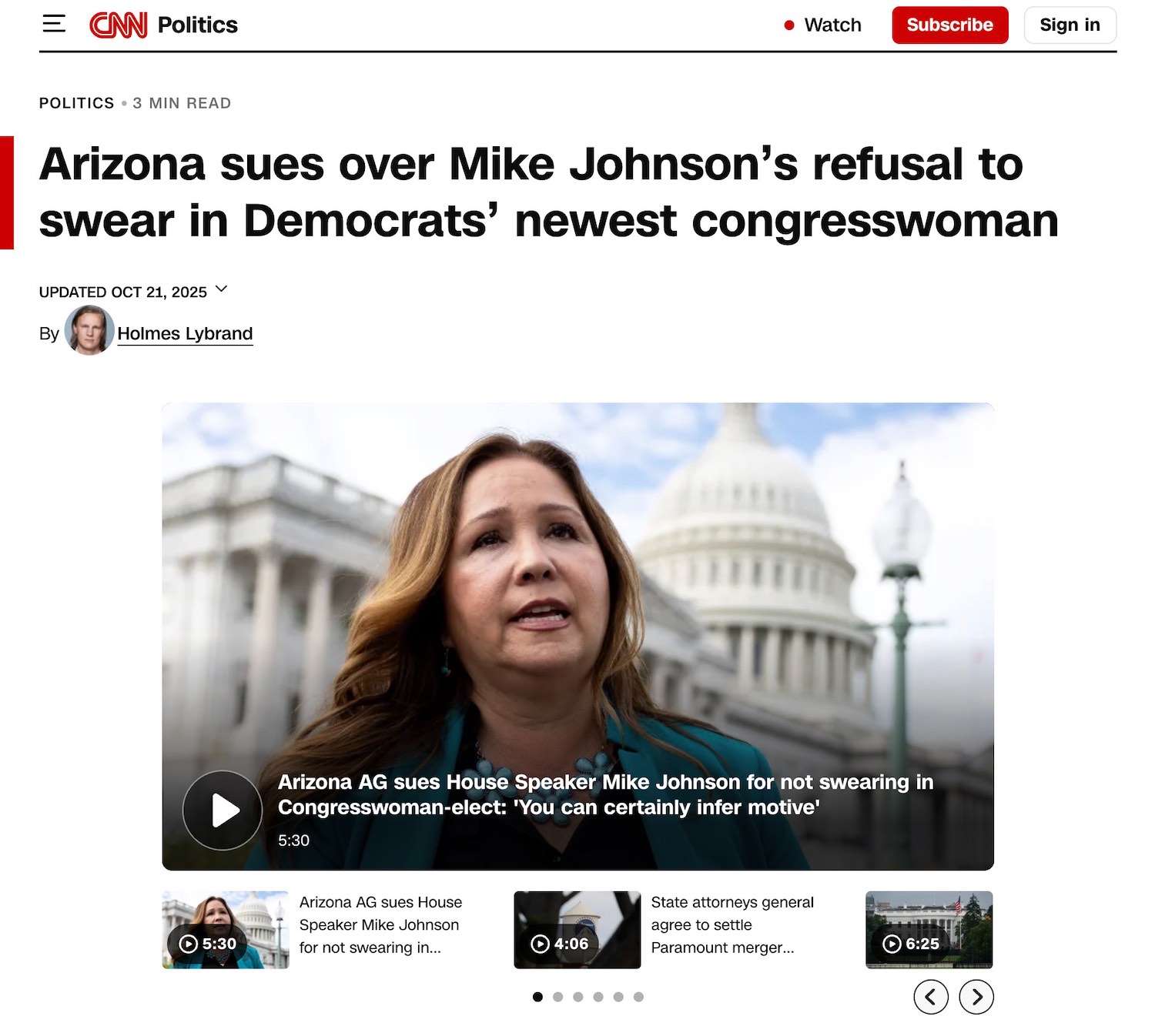
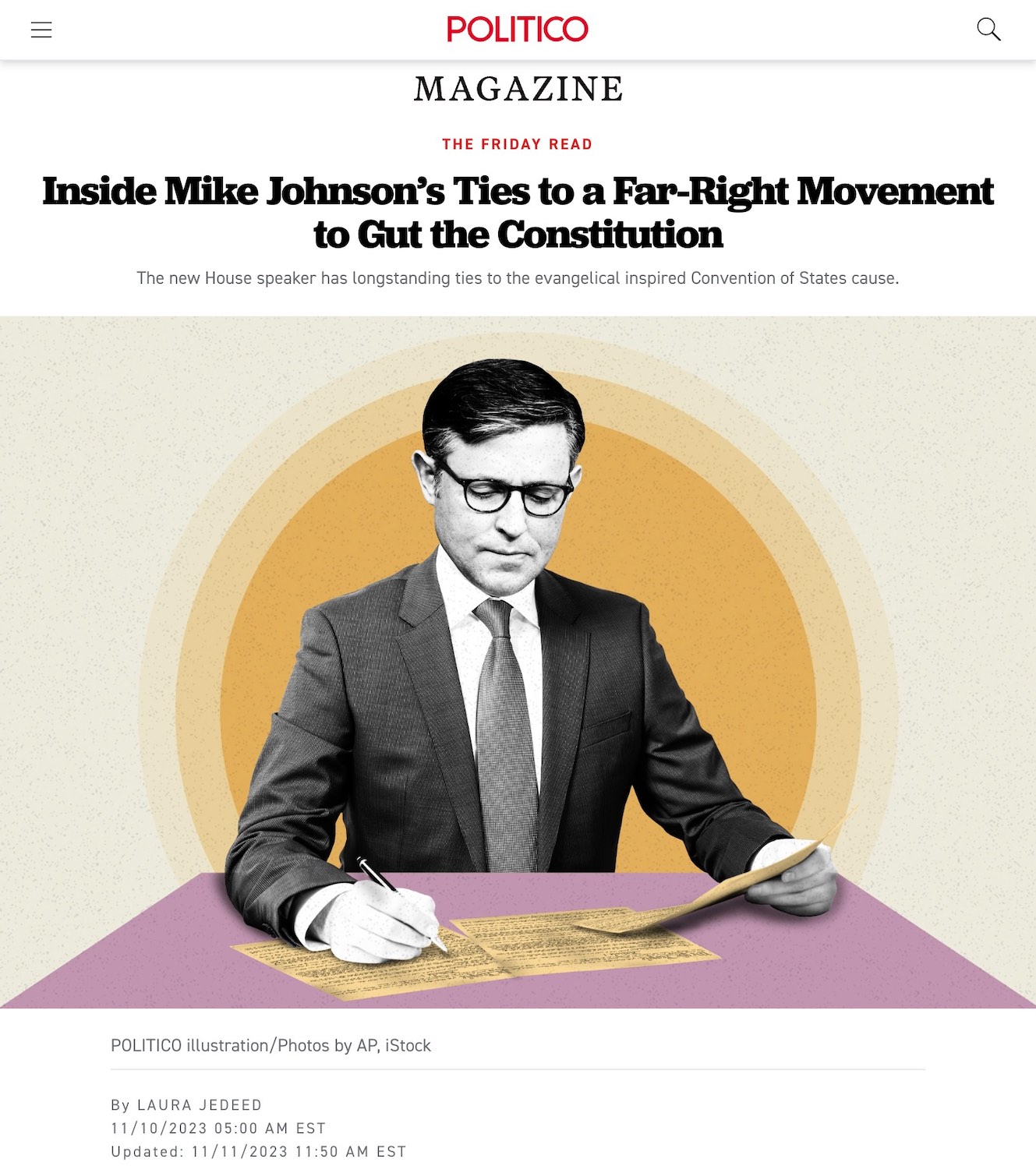
Nancy MacLean: I think the best way to convey the stakes here is to look at an individual. That individual is House Speaker Mike Johnson, who hails from the state that brought the Louisiana v. Callais case. If he wasn’t familiar to you before, he’s familiar recently for refusing for seven weeks to seat the duly elected Arizona Representative Adelita Grijalva, because she would cast the decisive vote to release the Epstein files that Trump didn’t want released.
But I also want to talk about Mike Johnson because we’re talking about how African Americans, and through African Americans, our wider democracy will be harmed if section 2 of the Voting Rights Act is also gutted, after section 5 was previously gutted by the Roberts Court. Such a ruling, coming alongside the unheard-of mid-decade gerrymandering Trump is pushing, would effectively give 27 more safe seats to this now openly authoritarian party. And that would be enough to assure enduring one-party domination of Congress and the American public policy agenda.
So what kind of representatives can we expect to get elected if that happens? Fair Fight and Black Voters Matter did a study of this and found that, combined with the efforts that Trump is making to do absolutely unheard-of mid-decade gerrymandering, combined with that this gutting of the Voting Rights Act would likely yield as many as 27 more seats for Mike Johnson’s party. What kind can we expect if there are 27 more people in this kind of mold?
Mike Johnson has been a consistent enemy of civil rights. In fact, I don’t think he’s ever found any civil rights measure of any kind that he would support. He has said that diversity, equity and inclusion “destroys everything that it infects.” We’re talking about measures to make it so that all of us can be fairly included, including people with disabilities that the Right apparently doesn’t even care about.
Mike Johnson is really only in Congress because of the long history of billionaires—particularly fossil fuel billionaires—and Christian nationalists organizing together. They fused from 1981 forward in a group called the Council for National Policy (CNP) to build out a politics that would please both coalition partners at the expense of the rest of us. CNP has since then kept coalition-backed Republican elected officials marching in lock step. (See Anne Nelson, “Holding Democracy Hostage” – ed).
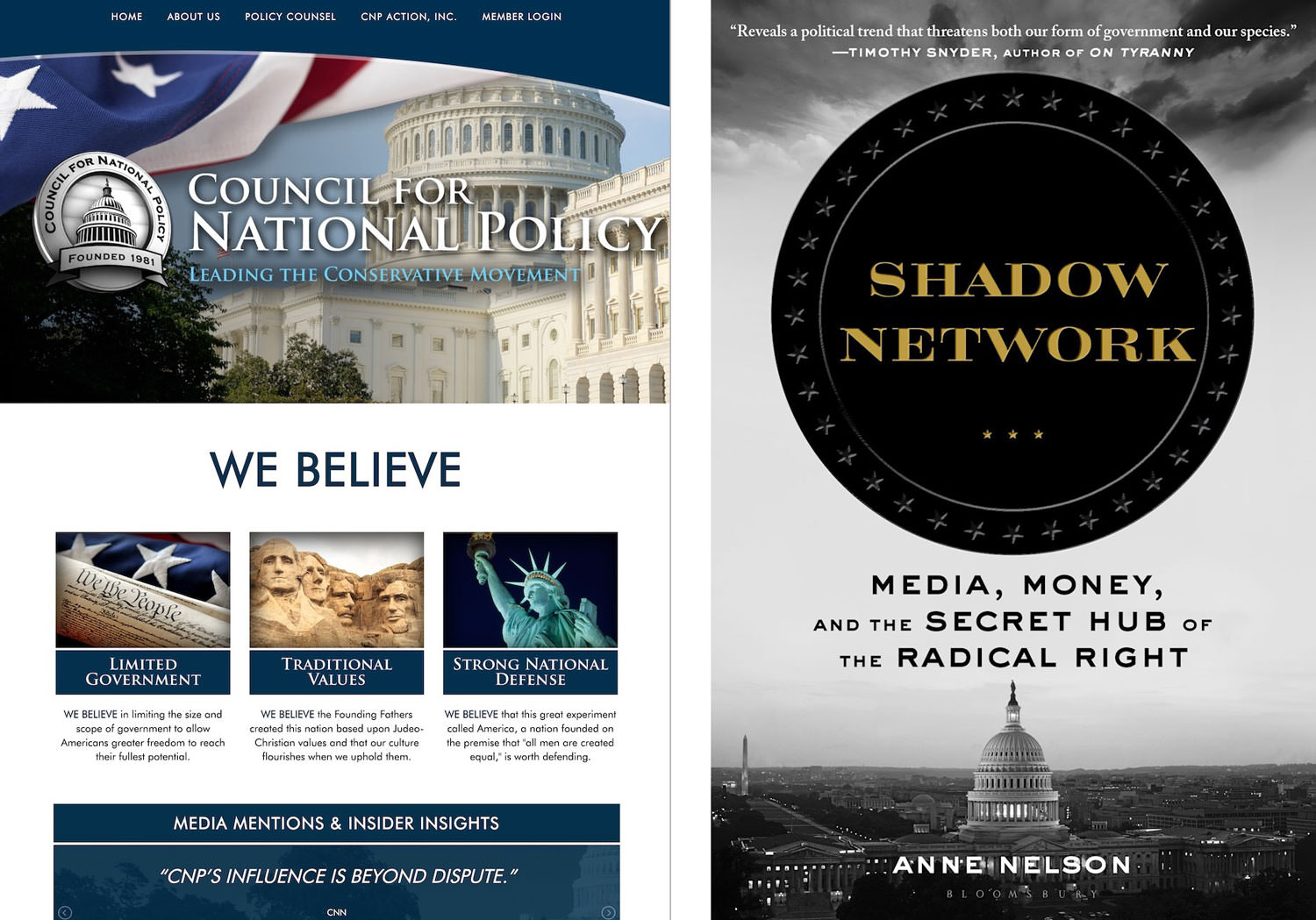
Mike Johnson is very clear about who groomed him for the power he holds and his debt to them. He gave a speech to the CNP in 2019 where he said, “Probably all of my biggest heroes are in this room tonight. I mean, I grew up in the movement… Tony Perkins, I was his bag boy…. And Kelly Shackelford is one of my mentors… I was telling Morton Blackwell, I’m in Congress primarily because I called [Morton] for help, and he got me here. I owe you all so much.” Who were these folks? Tony Perkins, from the Family Research Council; Kelly Shackleford, from First Liberty Institute; and Morton Blackwell, who runs the Leadership Institute.
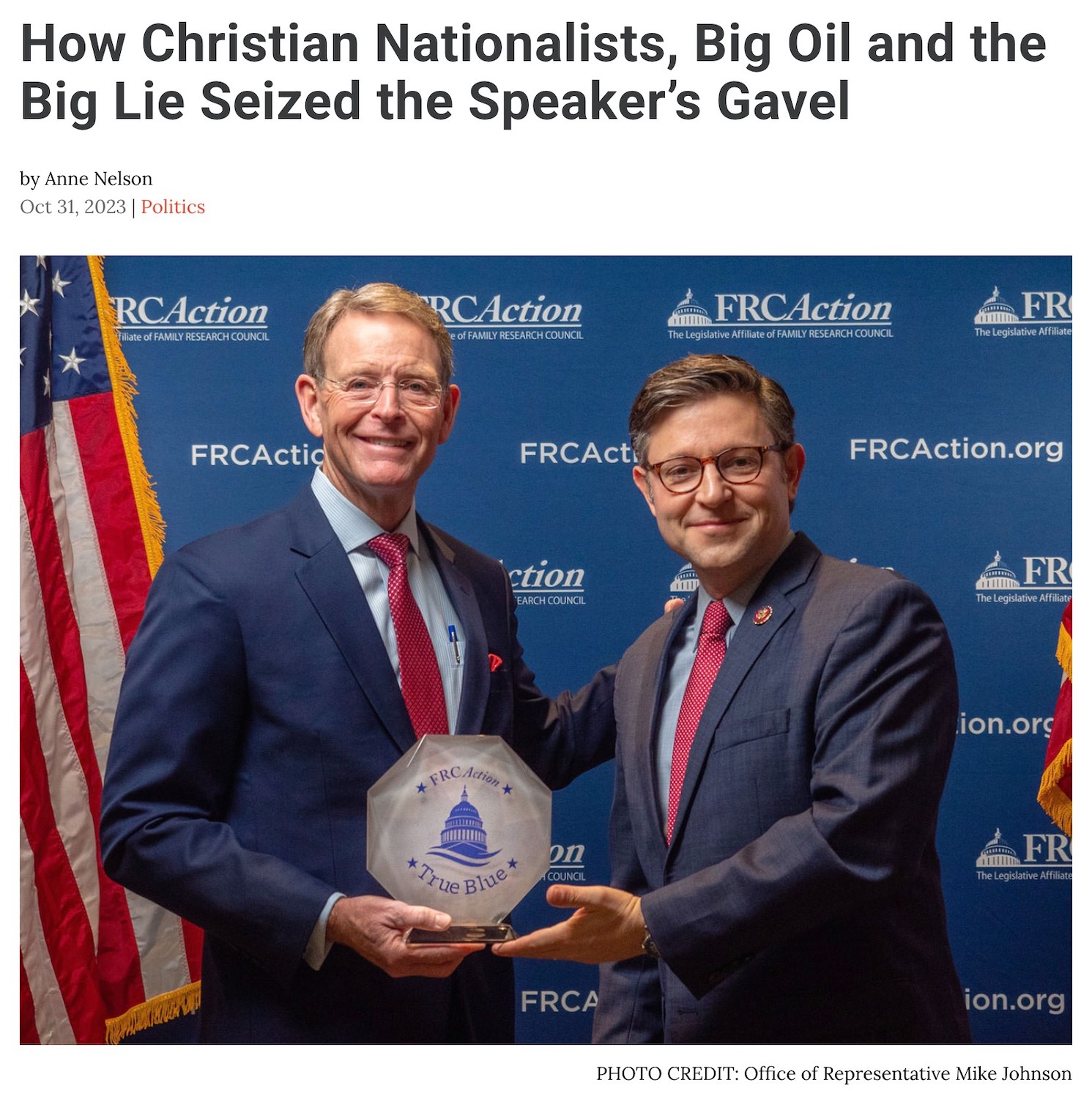
So clearly those interests will be over-represented if the court rules for Louisiana: these groups comprise some of the most vehemently Christian Nationalist, anti-feminist, and homophobic bodies in the country. Mike Johnson also did his early legal work with a group called the Alliance Defending Freedom. This group brought most of the anti-gay U.S. Supreme Court cases. But it also now operates internationally, trying to find embers they can throw gasoline on to inflame homophobia to move their larger agenda.
What kind of agenda do Mike Johnson’s allies have? We can look to Louisiana itself to see more of what’s in store if the Roberts majority further guts the Voting Rights Act and the state sends more representatives on this model to Congress.
In brief, more Cancer Alleys. Cancer Alley is an 85-mile stretch between Baton Rouge and New Orleans that is the most polluted place in the country. It has over 200 petrochemical plants and refineries that are daily spewing out carcinogenic air and water to the population, which suffers all kinds of illnesses from the levels of pollution that are allowed to come out from Cancer Alley—while Mike Johnson fights against corporate regulation.
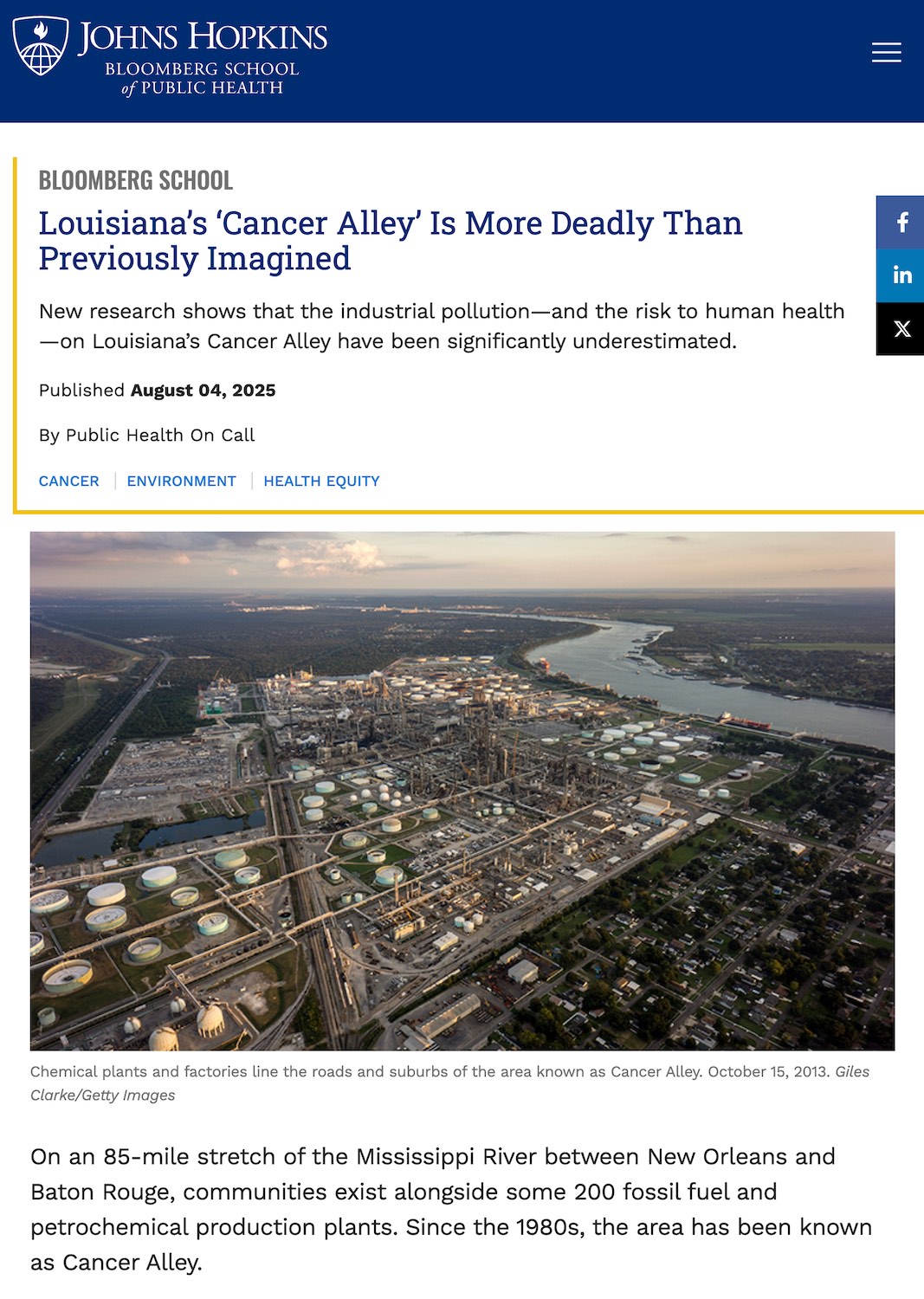
And of course, Louisiana is a poor state, with more people per capita in poverty than any other state in the union. Many of them African Americans who are descendants of those who worked the plantations that once operated in Cancer Alley. Because all these Deep South states that had elites who grew rich from owning human beings and from the production of enslaved people became poor when slavery ended and they still tried to keep Black people down rather than let all rise together.
Mike Johnson has done everything he could to end the Affordable Care Act and to rescind Medicaid expansion for the health care on which so many people in his own state, in his own district, in his own community, depend.
And of course, he opposes the unions that might be able to do something for the working people, Black and white, of Louisiana.
I think it helps us to look not only at who will be harmed, but also at whose power will be grossly enlarged if the Voting Rights Act is further gutted by the Roberts majority. Mike Johnson gives us a perfect demonstration of how things that are done to harm African Americans and undermine multiracial democracy will come for everyone in the end.
Kimberlé Crenshaw: Thank you so much for that, Nancy. And let’s add to the list the effort to undermine environmental racism as a framework to deal with what’s happening in Louisiana’s Cancer Alley. And of course, the overall point of anti-Blackness, this is not just Black people who suffer. It’s everybody who suffers from exposure, everybody who suffers when they lose their medical insurance. Anti-Blackness can be a vehicle that causes people to think, “well, that’s not about me, that’s about them”—when in fact it is about all of us.
On that note, Janai, let me come back to you. You gave a wonderful speech about the Voting Rights Act, about the assaults on it being made possible by the specter of anti-Blackness. That when people hear it and they think, “oh, that’s just about them,” they’re wrong about it being just about them. So I wondered if we could look at a couple of aspects of the assault on the Voting Rights Act that may be a window to seeing how anti-Blackness is functioning. In particular, the asymmetry between what Black folks have to prove in order to make a credible claim of being discriminated against and what white folks have to prove. There are huge differences. What are some of them, and what kind of story are they telling us about why it’s so asymmetrical?
Janai Nelson: Professor Anderson laid it out. The case you referenced, Veasey v. Abbott, is a 2014 case that challenged this voter ID law, and so many people couldn’t understand, “well, why can’t people just produce an ID?” I got that question constantly, and we had to do exactly what Professor Anderson did, which is to explain that not everybody possesses the same degree of identification or resources to get that identification in equal measure. What we do possess in equal measure is, at least in theory, the right to vote. It is the currency that we all hold, right? It’s the one thing that’s supposed to equalize—the one person one vote theory, right? That is out of Reynolds v. Sims in the 60s but it has never fully come to fruition.
And what you’re referring to, Kim, is what happened to the Voting Rights Act soon after it was passed in 1965. It had a runway of about a decade where we were still perfecting it. We were still reauthorizing certain parts of it, because the preclearance provision that we talked about is not a permanent provision. It needed to be reauthorized every five years or so, and then eventually, 25 years. In the ‘80s and certainly by the ‘90s, there came these claims that were effectively “reverse discrimination” claims, where you had white voters, primarily, saying that these new districts that were enabling Black people and other people of color to elect candidates of their choice was somehow discriminating against them. Those are called Shaw claims, from Shaw v. Reno, and those claims don’t technically have a different standard of proof based on race but based on the race of most of the litigants, it is effectively a different standard.
To prove a Section 2 claim, we have a very complicated test. We start off having to prove three different preconditions before we can even get to the meat of the analysis, and then we have to look at the totality of the circumstances. There are about nine factors that are not required, but that we have to go through, and all manner of proof, including expert witnesses. It’s extremely expensive. It’s protracted litigation. It is a huge burden to prove that racial discrimination is infecting the electoral process. That’s because we no longer have Section 5, so we don’t have that pre-vetting of new laws. So to prove discrimination, we have these very onerous cases.
Whereas a white voter can come in and say, “I don’t like the shape of this district, let alone why it looks the way it does.” Or “now I’m forced to vote with people of color, and I can’t control the outcome of the election, and therefore it is discriminatory.” On behalf of the 80 percent of folks in the state who are usually in the opposite position, I say, “Welcome to our world. This is the world we constantly live in, where our votes are not able to effectuate an outcome.” And so to say that in a few districts, there ought to be equitable control over outcomes, or at least the opportunity to elect a candidate, that is not discrimination. That’s not reverse discrimination.
We have to get away from this idea that somehow talking about race, considering race, taking account of race, is race discrimination. When you put that against a backdrop of centuries of disenfranchisement and discrimination, it’s just wholly illogical to think you’re going to solve a problem by just somehow neutralizing everything at a point in time when discrimination has played such a role in creating an imbalance.
So that’s what we are experiencing in the courts, and that’s part of what Louisiana v. Callais demonstrates. The shape of the district that these self-titled “non-African American voters” are concerned about owes to the fact that the State of Louisiana sought to protect Mike Johnson’s district. It sought to protect the district of the majority leader, Steven Scalise. It sought to protect other incumbents. And so it had to draw lines around those incumbents to make sure that they weren’t going to be voted out of office. That is wholly appropriate. You know, regardless of what you think of those individuals, that is an appropriate act of the legislature. And that’s why we wound up with a district that now people can point to and say, “well, that’s reverse discrimination.” So, we’re hoping that the Supreme Court is more sophisticated than that and is willing to see it for what it is.
Kimberlé Crenshaw: Yes, praying, hoping, pouring libations, on that question of how the double standard then leads to having to defend race-conscious remedies against the assumption that race never plays a role. In fact, as they’re drawing districts, they’re aware of race, race is being taken into account all the time.
Janai Nelson: All the time. The Supreme Court acknowledged that. Justice O’Connor said that decades ago, and everyone takes that as a given. Of course, you know that a particular racial group lives in a particular area. You know what their common interests are. Of course, you’re aware of race. Why wouldn’t you be as long as you’re not using it for malicious reasons? That should not be an issue.
Kimberlé Crenshaw: And yet you had a long exchange during the argument, where it seemed as though there was an effort to force you into saying that using race as a factor in creating an opportunity district was race discrimination. First of all, I wanted to say kudos to you. A lot of us are not cut out to have a poker face and be able to know what the person is trying to force you to say and still not fall into it. But this assumption that using race for remedial purposes is race discrimination, intentional racial discrimination, is part of the ideology of color blindness that they’ve been touting for the last 20 years. It’s using a conclusion in an exchange that’s asking you to affirm, a little bit like, “do you still beat your wife?” They were trying to trap you.
Is there any lesson when we look at how far the conversation has gone from an earlier period, where it was recognized that acknowledgement of and use of race as a remedial strategy was clearly understood as constitutionally acceptable? Even Justice O’Connor said you can use race as remedial when we’re trying to remedy something. So how did we get to this point where there’s this blanket claim that any use of race to remedy is discrimination, but uses of race to protect Scalise or whatever is okay?
Janai Nelson: Well, it’s always been contested, right? It’s not as if there was ever a full acceptance of it and then we veered away. We know that immediately after the ratification of the 15th Amendment, there was, you know, a backlash. We know that when the original Civil Rights statutes and laws were passed, by the end of the 1800s there was a response from the Supreme Court saying, “When will Black people cease to be the special favorites of the law?” There’s always been this rejection of the idea that we can acknowledge our racist white nationalist history and try to do everything possible to correct it, including affirmatively using race.
We’ve seen this tug of war, back and forth, back and forth, and unfortunately, it’s become embraced by some of the supposed neutral arbiters of our law. We heard this when Obama was elected, and everyone thought we were post-racial. Just because of a single—very consequential—but a single election. America has always had a desire to pretend that its racial history is not currently impacting our present, or that our present isn’t also racist, and that there aren’t also racist strategies and structures and policies that perpetuate white nationalist ideology. That’s just the underpinning of this country.
I don’t think we’ll ever rid ourselves of that inertia, which is why we need structural laws, why we need these muscular laws to be that counterpunch and serve as the equal and opposing force to that inertia.
Kimberlé Crenshaw: There’s another moment [in the oral arguments] where Justice Scalia resurrected the theory of racial entitlements, the idea that race-conscious remedies are immoral and lead to unjust outcomes. To quote him, “whenever a society adopts racial entitlements, it is very difficult to get rid of them through the normal political processes.” In effect, he was claiming that the Voting Rights Act gave a gift of racial entitlement to Black people, and because of that, the normal political processes don’t work. I guess the first thing one can lift out of this is the idea that a civil rights protection, a remedy to the long history of exclusion, is itself an entitlement. It’s extra, as the young people say today, and so if it’s extra, then taking it away is not discrimination. That’s functionally what he’s saying.
But in fact, it’s actually required to create equality.
Carol, give us a historical arc of we’ve seen this over and over and over again, and now we’re seeing it.
Carol Anderson: This is what happens when you don’t know your history, when you have “patriotic history” that is ahistorical, where it’s ideological and not evidence based. That allows the Civil War to be called the Lost Cause, or the War of Northern aggression.
And I’m like, I’m sorry, but didn’t the South fire on the North first in the so-called War of Northern Aggression? The Lost Cause tries to make slavery noble. Similarly, really bad history is when you can turn Black people voting and getting elected into something akin to an assault on civilization— as “Birth of a Nation” did. That horrible, horrible film basically said Black folks went wild during Reconstruction because the strong, benevolent hand of whites was no longer there like during slavery. “Birth of a Nation” depicted Black men sitting in the legislature with their feet up on the desk, eating fried chicken and watermelon. And the only piece of legislation they passed was that Black men could have sex with white women. After that, according to the film, the legislature adjourned. Their work was done. That is a narrative steeped in Black corruptibility.
And so moving from film to reality, when Mississippi was putting through its Mississippi Plan of 1890 it kept hollering “voter fraud!” And what it was hollering was that when you have all of these Black people voting, the state can no longer have clean, good democracy, clean, clear elections, because Black people are inherently fraudulent, inherently corrupt and inherently criminal. When that becomes the narrative, then removing them is not destroying democracy. Removing them is actually a way to enhance democracy.
Enhance so much that by 1940 when the world was fighting Nazis, only 3 percent of age eligible African Americans were registered to vote in the poll tax South—3 percent—and in the 1942 election, which was a midterm election, there was only a 7 percent voter turnout rate. I think y’all need to hear me: 7 percent of the electorate turned out to vote for federal officials! Vote for US senators, vote for congressmen. And those people because they only had to respond to 7 percent of the electorate were sitting on top of congressional committees because of their seniority. They’re sitting as the chair of the Senate Judiciary Committee. They’re sitting in all these key areas that can block or warp legislation.
When you don’t know that history, you don’t know the history of what the GI Bill did. The GI Bill was supposedly to honor our veterans. Honor the folks who were fighting against Nazis and fighting against fascism. But the way the law worked, it said, you can have all these incredible benefits as a veteran. You can go to college free, you can get a really low interest loan to buy a house, and you don’t have to really put any money down—but this federal program will be administered by local rules.
So in Mississippi, because of the mandate of local administration, in 1947 there were 3,000 GI home loans approved, but only two were to African Americans.
Let’s take Georgia. I live in Georgia. In Georgia in 1946 Eugene Talmadge was running on a white supremacist platform for governor. Two years earlier, in 1944 Georgia got rid of its poll tax and lowered its voting age to 18 because, it said, we have all of these folks fighting for democracy. We need to show that we value them. The NAACP looked up and went, Yeah, we do. And launched a major voter registration program in Georgia. Black folks were signing up to vote, hungry to vote, wanted to vote. Tens of thousands got on the voter rolls.
Eugene Talmadge looked at that surge in Black registered voters and saw a threat because he and his ilk didn’t believe in multiracial democracies. And he was telling his followers, take them out. Take them out. Take them out. Violence rained down on African Americans in Georgia in 1946,including a quadruple lynching in Monroe, Georgia. There was also Maceo Snipes, a Black veteran who voted in Taylor County, Georgia, and as he walked up to the polling place to vote, there was a sign over the door that said something like, the first Negro that votes, that’ll be the last thing he ever does. He was defiant, “I fought fascists. What you got?” And he went in there, and he cast his ballot. He was the only Black person to vote in Taylor County. A couple of days later, there was a firing squad, and they laid Maceo Snipes out. His mother got him to a whites-only hospital, where they put him in a closet, and he sat bleeding for hours upon hours upon hours. But we value our veterans, don’t we? It took him two to three days to die.
So the message is, you vote, you die. You vote, you die. And this is the history that they don’t want us to know. This is the history that they don’t want us to wrestle with. What are the implications of having that kind of terror? There’s a scholar who was at Clemson University, and she did a study of lynchings, and she found in areas where there was a lynching, Black voter turnout and Black voter registration stayed low in those areas, really low in those areas, because that trauma is still in the soil, it’s still in the memory. It’s still there.
And so when you have the folks on the Supreme Court calling voting a privilege, calling it an entitlement, it tells you they don’t know or don’t want to know this history, this American history. And this is also why the right-wing is going after history. This is why they’re going after the books. This is why they’re going after the curriculum. This is why they’re going after African American history and African American Studies, because these are the things we’re not supposed to know. Because when we know this, then we govern ourselves accordingly. You will fight for these rights. You will stand up.
Kimberlé Crenshaw: Okay, Georgia. My father’s from Louisiana, New Orleans.
First, despite so much of what you just shared, what we just heard, there’s often a sense that the history of white supremacy is a long time ago. It’s kind of reading the Black and white pictures and all that, right? But we were born during a time where many of these laws were still on the books, so the history is not nearly as long ago as people want to believe.
And so Nancy, I want to bring you in with the work that you’ve done to link the broader objectives that are being served by weaponizing anxiety, weaponizing anti-Blackness, towards broader goals that the Tech Bros and others have been pursuing. While this is a new faction, some of the ideas that they are promoting go all the way back to the defense of slavery. In Democracy in Chains, you’ve written about how some of the ideas that are now being pursued in the name of liberty go all the way back to how John C. Calhoun defended slavery in the name of liberty, their liberty to own and dominate the Black people in bondage.
Give us the story about how a set of ideas that we thought were long gone, had been vanquished by the Civil War, the creation of the 14th Amendment, stay in the soil and come back up. How they are now being mobilized by Charles Koch and all the others to pursue an agenda not just of suppressing a multiracial democracy, but shackling democracy period. The whole idea that we have a right to vote and determine policies, there’s a very powerful faction that says, No, we don’t like that anymore. So what do we need to know about them?
Nancy MacLean: I think that it’s important to dig in here. It’s clear that for most MAGA voters, anti-Blackness is the point. They like white supremacy; it flatters them. They are comfortable with it or at least are not disturbed enough by it to not vote for MAGA and its leader. So we know that, and that’s really important.
But there’s another group of people that we don’t pay enough attention to, which is these extremely wealthy people who are running the show and don’t like the idea of any restraints on corporations like those that operate in Cancer Alley, people like the fossil fuel billionaire Charles Koch. And now we have the Tech Bros like Peter Theil and Elon Musk joining them because they don’t want to face any regulation in their multibillion-dollar enterprises. It’s important to understand that when we’re talking about voter suppression and these anti-democratic measures, it’s not just about skin color for these hugely rich donors.
But it’s not just a partisan thing either, as so many whites who don’t know Black history imagine. The Supreme Court has allowed racially targeted gerrymandering saying that, “Oh, this is just a partisan thing. You know, gerrymandering has always been partisan; this line-drawing is just a partisan thing.” No, this is about, as Carol said, history. Blacks and whites have a very different history in this country. And for African Americans as a predominantly working-class population that came here enslaved and lived with that experience and then Reconstruction and its brutal defeat and then Jim Crow and the state-enabled terrorism that Carol talked about, there is a very deep-rooted awareness that maybe we shouldn’t trust state government or private corporations.
After all, enslavers were the first predatory capitalists in this country. They launched racial capitalism, so there’s wisdom in being cautious about letting those kinds of people have so much power. African American communities know in their bones that it took federal power, federal intervention, to end slavery. It took federal power to stop Jim Crow, to end segregation. It took federal power to at least try to mitigate generations of favoritism for whites in school, housing, and jobs. Carol described that favoritism for whites in the GI Bill, mandated and allowed by state administrators.
That lived history runs very deep in Black communities and shapes the kinds of policies that, not all, but most African Americans want. They—you—want to have things like well-funded public schools. They want to have things like labor rights. They want to have things like workplace safety. They want to have things like nondiscrimination. They want to stop environmental racism and protect the environment, all these kinds of things that make democracy better for all of us, right?
But that policy agenda that is so deeply rooted in a distinct history and you can see in almost any election or polls of African Americans—that policy agenda is total anathema to the billionaire class that wants to have free reign to do whatever they want, whenever they want to and to whomever. And that is why these big donors who call themselves libertarian—really just liberty for capitalists like Charles Koch— invest so much in in groups like the Council for National Policy, which groomed Mike Johnson and unifies the fossil fuel donors and white Christian nationalist operatives.
They use pincer moves. Example: inflame the Republican base with racism or homophobia, then use donor’s dark money to primary any Republican elected official who compromises with Democrats, whether it’s on taxation, to fund public schools, to act on global heating or discrimination or whatever. Combined, the donors and the base voters take those people out. Make it impossible for anyone except a reactionary to be elected in today’s GOP.
So in that sense, you could look at African American voters as being the first people to risk the minefield, to defend the things that all of us care about and rely upon—always out in front. That has gone on for generations, and this is a moment for the rest of us—I’m speaking to other white folks here—to pay back that leadership and courage and step up to the plate to defend the Voting Rights Act. Because, again, if you suppress African American political power, what do you get? You get the Mike Johnsons and Steve Scalises and Donald Trumps and all the rest of them.
So, we need to see both sides of this equation. I would never discount the reality of racism. It’s on display everywhere, especially these days on social media. But at the same time, we need to understand that there is this strategic calculation going on among the right-wing ultrarich and the operatives they fund about, as Carol said, how do we shave off margins of voters who would oppose our agenda?
(And by the way, it’s also student votes they’re trying to shave off, although that has not been litigated as much. The right has tried to suppress student votes for similar reasons—because they know that young people, by and large, do not share their policy agenda. They are much more likely today to value diversity, to dislike discrimination of any kind, to want to have debt-free college and affordable housing and not inherit climate collapse. Those policy preferences make younger voters also people that the right wants to drive from the polls.) So we are really in this together.
Carol Anderson: And could I add that in the 2016 election, we can see this in Wisconsin. Wisconsin implemented a voter ID law, and a political scientist did a study after that, and found that because of that voter ID law, in Dane County (home to UW-Madison) and Milwaukee County, 8 percent of whites did not vote—because of the voter ID law. 27 percent of African Americans did not vote because of the voter ID law. That amounted to somewhere between 16,800 and 23,250 people. The one who shall remain nameless, won Wisconsin by like 22,000 votes. And what happened in that state owing to voter suppression is you started seeing these right to work laws, these anti-labor laws. You started seeing the attack on higher education. You started seeing all of those things that the Black community and that young folks and that Hispanics and that Asian Americans and that liberal whites look at and say, “This is not the land that I want.”
But the first big hit is against African Americans. That’s the first big group of voters that they take out. And we saw that in Wisconsin. We are seeing that voter suppression is making a difference. This is not at the margins. This is determining outcomes in a significant way.
Kimberlé Crenshaw: And we also seeing and, Nancy, again, I’m drawing from your work, that the plutocrats are effectively using concerns about integrity of the vote and various other means to actually not just push certain people out of democracy, but to push the argument that democracy itself is not all it’s cracked up to be. There is a realm of liberty that they’re trying to protect by taking it out of the democratic process and not telling people that that’s what the agenda is. So we need to know that this is part of a long-term strategy, not just to tinker with democracy, but fundamentally move us out of the consensus around democracy. Why do we need to know that? How does it empower us to be literate now? What does it empower us to see?
Nancy MacLean: This is so important to understand: that Calhounian fear of democracy as the threat to predatory capitalists being able to do whatever they want, without accountability to the people. Today’s plutocrats have revived that way of thinking to try to undermine majority rule.
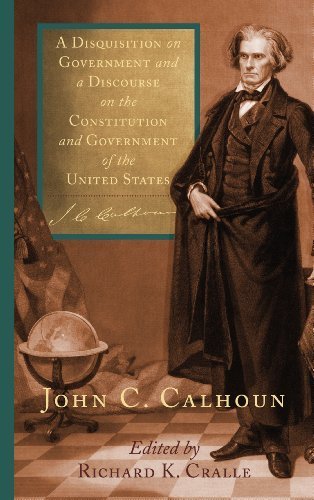
For folks who don’t know of John C. Calhoun, he was a militant enslaver, Vice President under Andrew Jackson, and then South Carolina’s U.S. Senator from 1832 until his death in 1850. He could see by the 1830s that democracy in the North was coming for slavery in the South, sooner or later. More and more people in the North were turning against slavery, but there was no way that he and other big planters who were profiting so handsomely from keeping people enslaved were going to give that up. So he tried to reinterpret American democracy. He wrote a big fat tome, A Disquisition on Government, to create a new theory of how American government works, basically going back to the Articles of Confederation to undermine federal power. Calhoun’s idea was to use the power of states to restrict national democracy.
And that approach is rearing its head in our time, on voting rights, reproductive rights and more. Justice John Roberts, in his Shelby County decision, said that some states—southern states—were being unfairly “disfavored,” picked upon, under Section 5 of the Voting Rights Act with its preclearance requirement. (Recall Kim mentioning that Antonin Scalia claimed that the long bipartisan backing of the Voting Rights Act really amounted to the “perpetuation of a racial entitlement” that would be “very difficult to get out … through the normal political processes.”)
Well, John Roberts said in his Shelby County majority ruling that Southern states were being treated unfairly because there were no more problems of racial discrimination in the South. Supposedly color blindness had defeated that. Roberts said they were being disfavored and deprived of the equal sovereignty of states, a telling phrase. Right? We are back to the Confederacy with that line.
But Roberts was not inventing this out of whole cloth. He’s getting it from decades of legal scholarship that has been underwritten by obscenely rich donors and promulgated by organizations like the Federalist Society, which now has six justices on the Supreme Court. That supermajority of six does all kinds of things that are radically anti-democratic.
One that will maybe feel real to a lot of people, particularly if you’re from a red or purple state like me, is the right has taken up neo-Confederate thinking to push what they call “competitive federalism.” Now, that sounds like the most boring abstraction you can imagine with all those syllables, but if you’re from a red state, it’s affecting your daily life, because what they’ve used those ideas to do, through the American Legislative Exchange Council and the State Policy Network, is drive a race to the bottom, to create a downward spiraling competition among states for corporate investment that has led to lowering corporate taxation to fund the schools, massive cuts in education from K through 12 through higher education. In my state of North Carolina, once a beacon to the Deep South, the Republican legislature drove us to Mississippi’s level. So, too, they cut environmental regulations, labor protections, voting rights and more—to empower oligarchs.
All of this can be traced to the 1950s revival of Calhoun’s approach to government begun by James McGill Buchanan, a donor-funded economist I wrote about in Democracy in Chains. Even his own colleagues saw the kinship between his school of thought and John C Calhoun’s.
So, yeah, this hostility to democracy has a long pedigree and history—and vast donor backing—we really need to understand if we are going to grapple effectively with the crisis that we are facing.
Kimberlé Crenshaw: And a future that they are not afraid to get behind, a future which one of them has described as one where we people will move from where they are to poorer, poorer states that they can afford. Where we will have favelas like Brazil and some of the poorest countries in the world. It’s Darwinian, their view. They’re not afraid at this point to embrace such things as the cost of limiting democracy.
So, on the theme of things that are back that we never thought we’d see again, I want to ask each of you, what’s something that has made a resurrection that you thought, my God, how is this walking in the body politic today? But yet, here it is.
Janai, what blast from the past can you not believe we’re seeing again?
Janai Nelson: We’ve talked about some of it—resurrecting these requirements to prove your citizenship to enjoy the fruits of the Constitution. I mean, Black people have been battling for our citizenship since our first days on these shores. The idea that we are now even challenging the idea of birthright citizenship (which is another case that we’re involved in), is ugly. That it is rearing its head in a way it hasn’t for a very, very long time, for many, many decades. The idea that that’s even out there in the ether as a question mark, that people are truly trying to debate that. And that then gives way to these requirements to prove your citizenship at the polls.
So even if they don’t win the birthright citizenship case, this administration has called citizenship into question, and for Black people, citizenship has always been with a little bit of a question mark, which is why you have those stories about people who fought fascism abroad and came home to equal, if not worse, discrimination at home, right? It’s because we’re not always seen as citizens and entitled to the fruits of that citizenship. So that is something that I think is recurring in a way that is deeply, deeply alarming.
Kimberlé Crenshaw: Nancy, what’s the blast from the past you cannot believe is happening?
Nancy MacLean: How about a constitutional convention? The last one was in 1787. But now the right has been organizing actively and aggressively since 2013 through groups like the American Legislative Exchange Council, the State Policy Network, and the Convention of States, all these donor-funded groups, to call an Article V Constitutional Convention to change the country, to amend the U.S. Constitution to make it the document they want it to be. The leading organizer of the effort told a sympathetic radio audience the goal is “to reverse 115 years of progressivism.” His words, not mine.
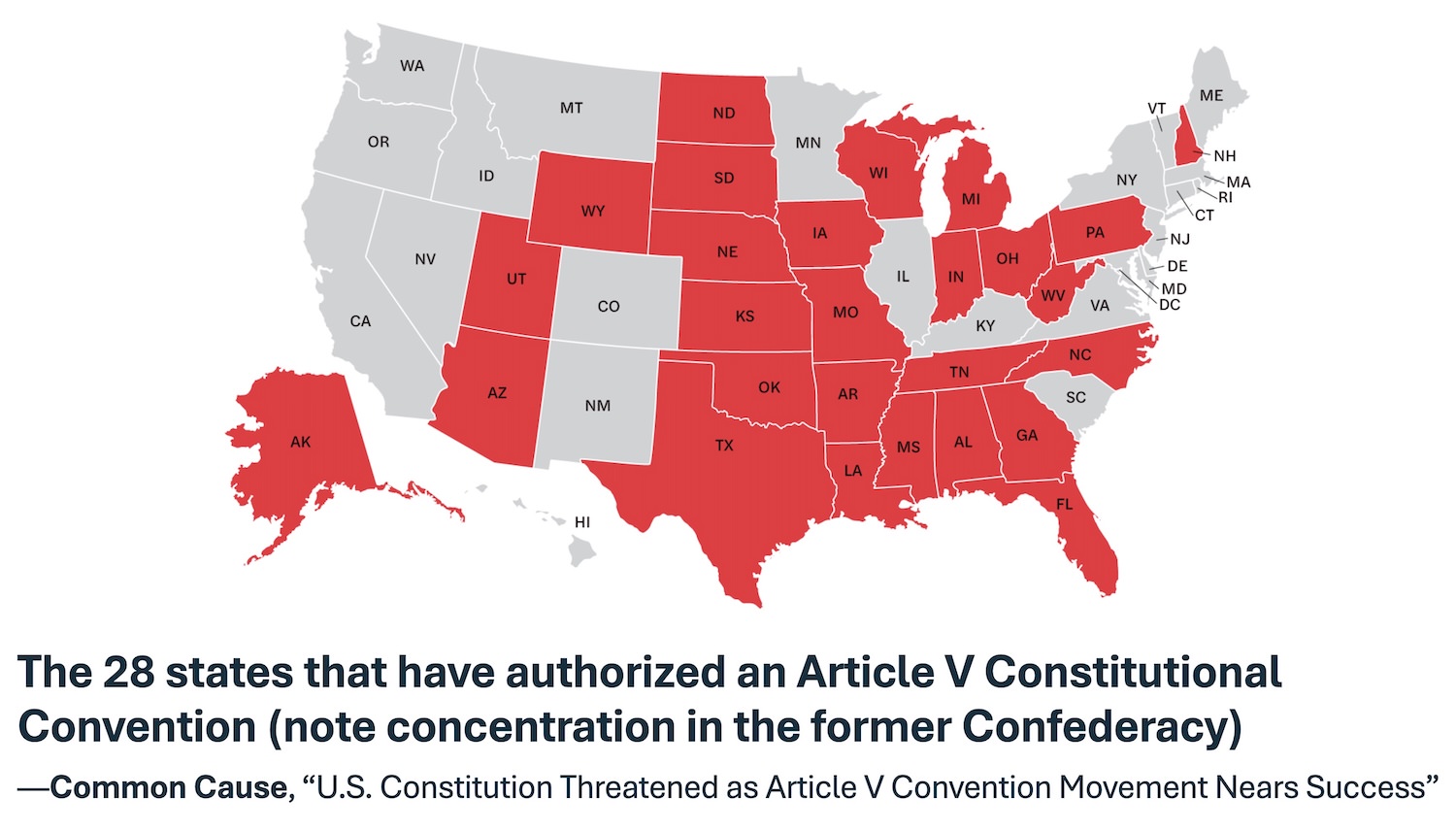
Common Cause has called this “the most serious threat to democracy flying almost completely under the radar.” How would it work? Article V of the Constitution provides two routes to securing amendments. All 27 of the amendments we have in the Constitution came through Congress then out to the states for ratification. Great things have come from this process. But there’s this other route that’s never been tried because it’s so risky, because there are no built-in guardrails. And that’s what today’s right is organizing for: a constitutional convention. And they’re so serious they’ve had three rehearsals at Colonial Williamsburg. They now have 28 of the 34 states required to call such a convention.
Kimberlé Crenshaw: Just be clear, they’ve got most of the states that they need?
Nancy MacLean: Yes, with a heavy concentration in the states of the former Confederacy.
Kimberlé Crenshaw: And their legal argument is that if they can get the number 34 (two-thirds of the states), they can actually go and literally rewrite the Constitution?
Nancy MacLean: Yep. And just to tease this out a little bit more, they realize that it will be very hard to get to 34 states honestly. Those last six are tough to enlist. So now the right has people writing in Federalist Society publications about a workaround. They call it “aggregation.” They’re going back and counting up other ancient state authorizations for a constitutional convention for other purposes and saying that with these, they already have enough so Congress must call a convention.
This is real. It’s happening. They have a white shoe law firm in DC that is ready to demand that the Speaker convene a convention. Which takes us back to Mike Johnson. As the Speaker in the House, Mike Johnson would be the figure to call it. So this is real, people. It’s unbelievable, but it’s happening. What they’re heading for is a new Confederacy in the manner of governance they seek. Not racial enslavement, but the kind of constitutional rules that enabled horrible things to happen by so elevating property rights over human rights.
Kimberlé Crenshaw: So now just think about the things that you didn’t think were possible five years ago that actually happened—what that looks like.
Nancy MacLean: On that point, I’d say Project 2025 from the Heritage Foundation, funded by the same kind of people on the right. Polls and focus groups found that over 90 percent of people hated the idea of Project 2025 and its particulars, even Republicans. But there was a credibility crisis, because nobody believed that a second Trump administration could pull it off, that they could manage to do what Project 2025 proposed, so most did not take it seriously enough. We are now living under Project 2025 because not enough voters understood how important it was, how dangerous it was, and that they would, in fact, go for it.
Kimberlé Crenshaw: Carol, what’s your blast from the past that’s shocking?
Carol Anderson: I’m thinking about Vivek Ramaswamy—and I try not to think of him too often. But you know, he’s running for governor in Ohio, and I grew up in Ohio, and one of the things that he’s talked about is the need to bring the literacy test back.
Now let’s talk about the literacy test. The literacy test could be whatever the registrar wanted it to be so, Mr. L., who was part of the village that raised me, he grew up in Jim Crow Georgia. His literacy test question was “how high is up?” Think about that. It’s unanswerable. And it’s blocking access to the ballot box. To citizenship. Other questions were, “how many jelly beans in this jar?”
And so I want us to think about what Ramaswamy’s literacy test would look like. He says all he wants is just a “civics examination.” What would that be in a place that has destroyed civic education in our public schools? Think about how this is targeted. Think about how they’ve already used voter ID, they’ve already shut down over almost 1700 polling places, they’ve already collapsed early voting and removed Sundays where Black folks go out to vote most—and now to try to implement a literacy test to vote? Yeah, I thought we were through with that. I didn’t think that we would be back at this place. But Lord, here we are.
Kimberlé Crenshaw: And we are here. So, let’s talk about here, and where do we go from here? I’m going to start it this way. Each of you are historians. You use history to defend a particular vision of democracy. And we all feel like there were moments where, as you said earlier, we’ve been sounding the alarm for over a decade, and the alarm hasn’t been heard.
Choose an inflection point where, if they had heard the alarm, something different could have happened. And what do we want the alarm today to do? So both what was the missed opportunity and what’s the opportunity we have now?
I’m particularly motivated to ask this question because of the quote that Janai used from Judge A. Leon Higginbotham, when he said he was there [in 1965] and saw the birth of this real democracy, and then he felt like he was watching it die. So if we are actually watching it die, we’re clearly not called just to stand by the bed and take the pulse and decide when it’s flat line. We’re supposed to be doing something. So what is that we can be doing that corrects the failure from the past? What can we do now that takes advantage of what we’ve learned about missed opportunities, Janai?
Janai Nelson: That’s such an important question. We’ve missed the boat and missed the mark so many times. I can point to so many different points in our history where we could have done so much more.
I mean, even the Voting Rights Act as much as I love it and worship it and use it as often as I can. Even the Voting Rights Act was a series of compromises. It said you have no right to proportional representation because there needed to be a compromise to get enough Congress members to pass it, and that’s part of why we are still dealing some of the cases that we’re dealing with now. Even though you have a state like Louisiana that’s one-third Black and still, even with the two districts, Blacks would be underrepresented in terms of the state’s congressional delegation.
So, I think that if we stop compromising people’s dignity, stop compromising people’s civil and human rights, and stop compromising the ideals of our Constitution—and embrace, once and for all, this project of creating a multiracial democracy and the sacrifice that it requires, we won’t see ourselves in this perpetual loop.
As I said, we will always have to fight against the inertia of the founding of this country and how ignominious that history is, but we’ve never really committed to the project of “we are going to remake this country anew.” And coming up on 250 years, I think it’s past time that we take up that mantle.
We are getting the most, I think, compelling invitation one could imagine. We are being dared and double dared and triple dared with the prospect of the most dystopian future that we have seen in a long time, and it’s up to us to decide whether we’re going to let this be yet another failure. Yet another opportunity that we see to embrace some false view of history, some false hope that we’re going to invest in leaders and a type of leadership that’s going to represent everyone and lift us all up—but that can only happen when you’re willing to cast aside certain members of society. And it’s always been Black people, indigenous people, and other people that you can force into some sort of oblivion and othering, right? It is always this factor of anti-Blackness that other people, not even those in power, will sign up for and are willing to vote over as long as it doesn’t affect them. They’ll trade us for their promised future, no matter how false it is.
Kimberlé Crenshaw: I’ve got to remind people of Derrick Bell’s short story about the Space Traders. If you haven’t heard of it, go read it. It’s also a movie. When you watch it, you’ll see precisely what we’re talking about.
And so, back to Louisiana v. Callais, this case is going to be decided in the middle of the big celebration of 250 years? And I can imagine a headline that the Supreme Court rules that the Voting Rights Act does not protect against political gerrymanders and strikes it down. And people don’t understand that this ruling was actually an assault on racial equity and equality. They hear that this was just a political gerrymander, as though, if Black people had been able to vote on slavery, and we voted with the party that was anti-slavery, they’d say it wasn’t about Black people. It was just partisan. That’s literally where we’re going.
So if you’re giving people a secret decoder ring, Janai, what do you want them to bear in mind, when they see that headline whenever the decision comes out, that political partisanship has always been used to mask what is really a unwillingness to address race.
Janai Nelson: I wrote an alarm article about this in 2021 called “Parsing Partisanship and Race.” I mean, it is punishment. Black people get punished because of their allegiance, often, to a particular party, and not rewarded for that allegiance.
But what’s really important is that, as you know, the Legal Defense Fund is a fully nonpartisan organization. We sue Democrats. We sue Republicans. We are about people getting the right to vote because we believe in Black people. We believe that whenever we get power, we don’t hoard it for ourselves. We help advance policies that are to the benefit of all of America. And you cannot point me to a single example that will contradict that statement. So, if we can help get that narrative out into the world—not the opposite one, that says we’re that we’re harmful, or that we are self-interested—that could make a difference.
If you look at history, if you look at facts, whenever we win, other people win with us. This country wins. We’ve transformed this country, against its will, into something that it claims to want to export to the rest of the world. That has made us the envy of the rest of the world: a multiracial democracy that is trying to be a highly functional one. So let us do our thing. Please. Let us help you. You know, help me, is what I want to say. But really that is how we need to decode this overlay of race and party, because so many think that this is just political warfare. No. This is race warfare. This is values warfare. This is true human warfare, and people need to understand that that is absolutely what is at stake.
Kimberlé Crenshaw: Thank you for helping us to understand that, Janai, and for being on the front lines.
Kimberlé Crenshaw: Nancy and Carol, both of you are historians, and I just have to say the way that you guys go into the archives—I sneeze when I imagine you guys going through those dusty papers and meticulously putting these stories together and revealing stuff underneath our noses—it is just incredible. But you saw a lot of good stopping points that didn’t happen, a lot of possibilities that could have taken us in a different direction. Give us one and how it should inform us now as to what we should be doing.
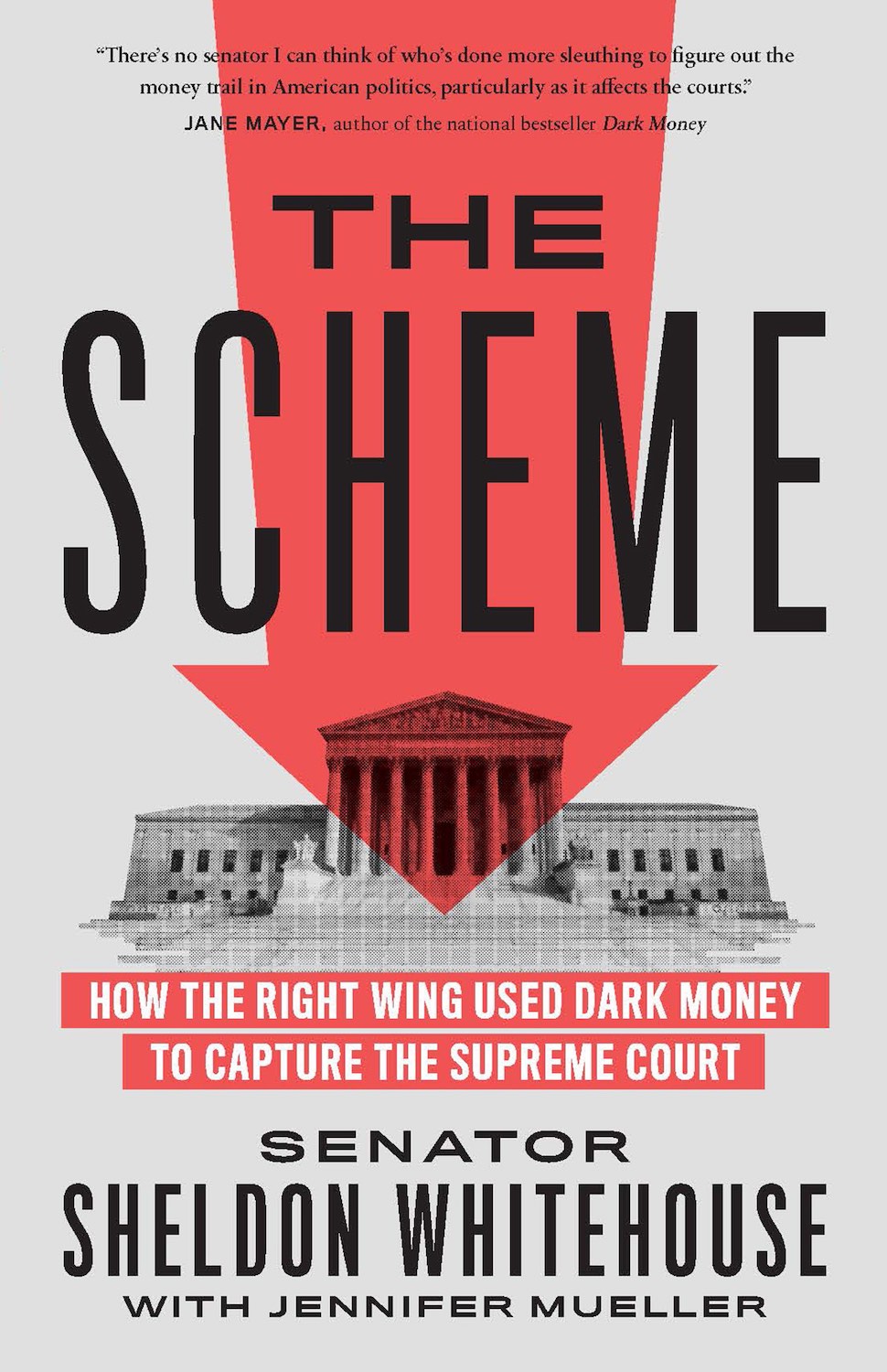
Nancy MacLean: I’ll take a recent example: the Supreme Court majority’s Citizens United ruling. That just opened the spigots to dark money driving our politics, by claiming that corporations have human liberty rights, which is absolutely absurd, which was never ever the case in our history. Corporations are not people who deserve liberty rights. Some people who have studied the way corporations operate say that if they were people, they would be sociopaths because of their amorality, lack of accountability, and so on. So you don’t want to give those people oversized speech rights, but the high court majority did. By the way, there’s a really good podcast on this by The Lever; it’s called “The Master Plan.” I recommend it for a deep dive into how we got Citizens United and why it’s been so damaging.
Kimberlé Crenshaw: What should we do now?
Nancy MacLean: First, I want to thank the people, especially young people, who brought us the election of Zohran Mamdani. That is a sign that when somebody comes out with an inspiring, inclusive message that speaks to basic needs but refuses to throw anybody under the bus, lo and behold, you can build a broad coalition, and you can win and inspire so many, with, what was it, 100,000 volunteers? So that was beautiful. But not my answer.
I am a former Chicagoan, and I have to say, if you’re wondering what to do, look to a place like Chicago when ICE came. Chicago (like Minneapolis later) showed us how to be human, how to be good citizens in the face of this authoritarian, racial fascist attack on especially in this case, brown people. People in Chicago rushed out to defend people in their community that they never have met. They might not know their names, but they see ICE coming, and they see people being racially profiled because of their skin color, because of the jobs they do. And Chicagoans see ICE breaking windshields, see mothers torn from children, see armed guards going into daycare centers, all of it, and Chicagoans aren’t having it.
Around Chicago, people, when they see ICE coming, are blowing their whistles. People are coming out of their apartments in pajamas. They haven’t brushed their teeth yet, but they see ICE coming to hurt people in their community, and they are coming out. Something really special is going on in Chicago and Portland and now Charlotte and other places where people are responding to this direct cruel attack on human beings where they live. And I have to say, as a historian, I love it.
I waited for this moment because I knew it would come, because we had the experience in America of the 1850 Fugitive Slave Act and the incredible northern fight against it. Then, the slaveholders, who were always pro states’ rights, decided they were pro federal authority when it came to getting back their enslaved property, so they demanded a law from Congress that essentially made every northern citizen who was free complicit in capturing people and kidnapping them to slavery. People did not like this, particularly free Black communities and their white abolitionist allies. In hundreds of communities, they rushed to help the fugitives and fought off these mobs. The stories are amazing.
So to me, this is history coming full circle. We know how to do this. We know how to be human beings. We know how to see when somebody is being cruelly, racially targeted, and we know how to help, and we know how to make noise, and we know how to change the public conversation.
Kimberlé Crenshaw: Carol, what’s your moment that could have gone differently, and what does it tell us we need to do now?
Carol Anderson: This is recent, when Biden was in the White House and the Senate was Democratic and the House was Democratic, and there was the John Lewis Voting Rights Advancement Act and there was the Freedom to Vote Act. We already knew what was going to happen from the other side because right after Shelby, we saw the voter ID laws. We saw the polling places shut down. We saw the curtailing of early voting. We saw it all, we saw who those suppression methods hit hardest. And, yet, when the Democrats had the power, they did not wield it. They did not use it. You saw Black folks thrown under the bus again. That was a key critical moment.
The stuff that we’re looking at now, when they’re figuring out how to get rid of mail-in ballots, like in Georgia, where I live in—and I know why Ray Charles sang “Georgia.” Because right after the 2020 election, which resulted in sending two Democrats to the US Senate and the electoral college votes to Biden, Georgia looked at that massive turnout, in the midst of a pandemic, and didn’t see the people’s commitment to democracy. Instead, the GOP in the state saw a threat and said, “Wow, did you see all those Black folks coming out to vote? Let’s figure out what methods they used to vote, and to shut those down.” And that’s what Georgia did. The inability to pass the John Lewis Voting Rights Advancement Act and the Freedom to Vote Act was one of those moments where history failed to turn.
And I’ve got a couple more. We never held white supremacy accountable for its assault on American democracy, and it has been assaulting American democracy for centuries, without consequences. So I look at the amnesty given to the Confederacy, as well as the amnesty given to the January 6 folks. And that assault on the Capitol on January 6 came from the anger that Black folk had the doggone audacity to vote, that Asian Americans had the doggone audacity to vote, that indigenous Americans had the doggone audacity to vote, and that Latinos had the doggone audacity to vote. Because, as one Alabama congressman noted, if you only count the legitimate votes, then Beetlejuice won. So that means that Black folks aren’t legitimate. They aren’t real American citizens. When we don’t hold folks accountable, that means folks of color, a multiracial democracy, is not legitimate. The message that these white supremacists learn is that there are no consequences to the damage they do and that they can keep doing this mess over and over and over. So that’s why I think this was one of those key moments where history failed to turn.
What would I do now? Okay, so I’m at Emory University, and we run a program called Imagining Democracy. And the way that I’ve argued it is I’ve said the enslaved had to imagine freedom even when there was nothing around them that told them that they could be free, but imagining freedom steeled their resolve, steeled their soul, gave them the kind of creative juice to resist slavery, to resist enslavement, to resist the gutting of their humanity and to fight for their freedom. Those coming through Jim Crow had to imagine what first-class citizenship felt like, tasted like, walked like, talked like, breathed like. Then they created organizations, mobilized, and launched the Civil Rights Movement. Today, in order to organize for that first-class citizenship, we have to imagine democracy. We have to imagine what it would feel like, what it would taste like, what it would be like. and then we have to organize and mobilize and fight for that democracy that we are imagining because we are worth it. Our children are worth it. Our future is worth it.
Nancy MacLean: To Carol’s point of imagining democracy and the power that we have, if we would use it, Bishop William Barber and his co-author Jonathan Wilson Hartgrove, in their most recent book, have this line that I love about how the right wouldn’t be investing the billions of dollars they’ve been investing unless they believe that we can win. They would not go to all this trouble if it was a done deal. So we have the power. Even when we feel like we don’t have the power, they know that we have the potential power, and that’s why they bring these cases like Citizens United and Louisiana v. Callais and do all the things they do.
Kimberlé Crenshaw: People don’t steal your garbage. They steal things that are valuable.
Sisters, thank you so much. Janai Nelson, Nancy MacLean, Carol Anderson, you all are national treasures.
* * * * * * * *
Kimberlé W. Crenshaw is a pioneering scholar and writer on civil rights, critical race theory, Black feminist legal theory, and race, racism and the law. In addition to her position at Columbia Law School, she is a Distinguished Professor of Law at the University of California, Los Angeles. Her most recent book is Backtalker: An American Memoir, published by Simon and Schuster.
Carol Anderson is the Robert W. Woodruff Professor of African American Studies at Emory University. She is the author of One person, No Vote: How Voter Suppression Is Destroying Our Democracy, long listed for the National Book Award, and a finalist for the PEN Galbraith Award in Nonfiction. She is also the author of White Rage: The Unspoken truth of Our Racial Divide, a New York Times bestseller and Washington Post Notable Book.
Nancy MacLean is the William H. Chafe Professor of History and Public Policy Emerita at Duke University. She is the author of Democracy in Chains: The Deep History of the Radical Right’s Stealth Plan for America, a finalist for the National Book Award and winner of the Los Angeles Times Book Prize in Current Affairs, as well as the author of Behind the Mask of Chivalry and Freedom is Not Enough.
Janai Nelson is the president and director of the NAACP Legal Defense Fund, the nation’s leading civil rights law organization advancing racial justice and equality. She argued Louisiana v. Callais before the Supreme Court. Nelson is a leading litigator and scholar on election law, race, and democratic theory.